Soccer, basketball, futsal, and general sports fanatic. I like to look at sports from a cultural perspective, especially how the world of sports influences society as a whole.
There was a time in world football when you could almost identify a team’s nationality simply by watching them play.
The English played with speed, power, long balls into space and an almost stubborn preference for directness. Playing for the set piece was preferred over long term buildup since they were very good at scoring from those plays; direct kicks and corner kicks were the, pardon the pun, cornerstone of the English game.
Spain, on the other hand, invented a style that was a hybrid of the Italian and Brazilian schools, and once that was pioneered by the tiki-taka style that originated in Barcelona. By the early 2000’s, the Spanish style was all about unlimited possession, using a seemingly interminable sequence of short passes that pinged all over the field. Holding the ball was seemingly more important than scoring. The goal was to wear out the opposition who had to defend for the majority of the game, a task that renders not only physical, but more importantly, mental exhaustion on opponents.
In the modern era of globalized squads and managers trained in the same tactical schools, those distinctions have largely blurred. Clubs borrow ideas from everywhere. A Spanish team can counterattack like an English one. An English club can suffocate opponents with possession like a Catalan side.
But occasionally, football reminds us of what it used to look like.
Barcelona’s 1–1 draw with Newcastle in the Champions League on March 10 felt like one of those reminders.
Because for ninety minutes, it looked almost like a duel between national football identities.
Newcastle played the quintessential English game. For a large part of the first half, pace and energy was prevalent. Direct balls into space. Power through the midfield. When they won possession they wasted no time turning defense into attack, driving forward with the kind of vertical urgency that has defined English football for decades.
Barcelona, meanwhile, were unmistakably Spanish. Possession first. Patience paramount. The ball moved side to side as they searched for angles and seams, preferring elaborate buildup over sudden bursts forward. If Newcastle’s instinct was to launch the ball into open space and chase it, Barcelona’s instinct was to slow the game down, control it, and carve their openings with finesse.
For the first fifteen minutes, Newcastle’s style looked overwhelming.
They came out like a storm — pressing, sprinting, forcing Barcelona into hurried passes and uncomfortable clearances. The tempo was ferocious, the kind of pace that makes technically gifted teams feel rushed and slightly disoriented.
But that kind of fury is rarely sustainable.
Gradually Barcelona began to regain control of the ball and, with it, the rhythm of the game. Possession tilted back toward the Catalans as they circulated the ball through midfield and attempted to impose their usual geometry on the match.
Yet just before halftime Newcastle reminded everyone what their preferred version of the game looked like.
They surged forward again, attacking with speed and purpose, whipping balls into dangerous areas and winning corner after corner. By the break they had accumulated six corners despite having roughly 13% less possession than Barcelona — a perfect statistical summary of the contrasting approaches. Barcelona held the ball; Newcastle made the moments count.
From the restart until roughly the 80th minute, the match settled into something of a stalemate. Barcelona passed, probed, recycled possession. Newcastle stayed organized and disciplined, choosing their moments rather than constantly chasing the game.
Even the TUDN commentators made the same observation that was evident to anyone watching: Newcastle had managed to dictate the rhythm of the match. Barcelona had possession, yes, but not control in the way they usually enjoy it. The English side had slowed the game just enough to disrupt Barcelona’s brand of football.
Chances were scarce. The game felt tense rather than explosive.
And then, late in the match, Newcastle finally found the solution.
In the 86th minute the breakthrough came not through some elaborate tactical masterpiece but through one of football’s simplest combinations. A quick give-and-go opened a sliver of space. A low, hard cross flashed across the penalty area and found Newcastle’s Harvey Barnes unmarked at the far post for a simple tap in.
It was brutally efficient — the kind of direct attacking sequence that had defined Newcastle’s play all night.
The Magpies had finally solved the Barcelona defense. And it looked like they would take a one goal lead into Spain for the return leg.
But football has a cruel sense of timing.
Deep into stoppage time, in the 94th minute, Barcelona found their lifeline. Dani Olmo received the ball just inside the penalty area and executed a subtle but devastating piece of skill: a feint to the left that froze the defender, followed by a quick dribble to the right that drew the inevitable foul and ensuing PK.
Lamine Yamal stepped up and finished it with the calm that has already become his trademark. The equalizer came with surprising ease, the stadium erupting in relief as much as celebration.
And just like that, a match Newcastle had largely controlled slipped away.
In truth, this was one of Barcelona’s poorest performances in many years. They struggled with Newcastle’s pace, looked uncomfortable under pressure, and never truly established the dominance that usually accompanies their possession-heavy style.
Yet somehow they escaped with a draw.
Football is often like that. One team plays closer to its ideal game, but the scoreline refuses to cooperate.
Newcastle will leave wondering how they did not win. Barcelona will go back home knowing they were fortunate. The second leg suddenly looks far more interesting than anyone might have expected.
Extra Time
Olmo’s goal was a result of a piece of tactical genius from Hansi Flick. Olmo came in late in the game and played the first 10 minutes at the back, using the Volpian buildup where a 6 plays on the last line of defense to help with the build of play from the back. This is odd given that Olmo is neither a defender or a midfielder but a forward. Having put the Newcastle defense to sleep, Olmo quietly slipped to the front, where his sudden move at the top of the box drew the PK that would produce the equalizer.
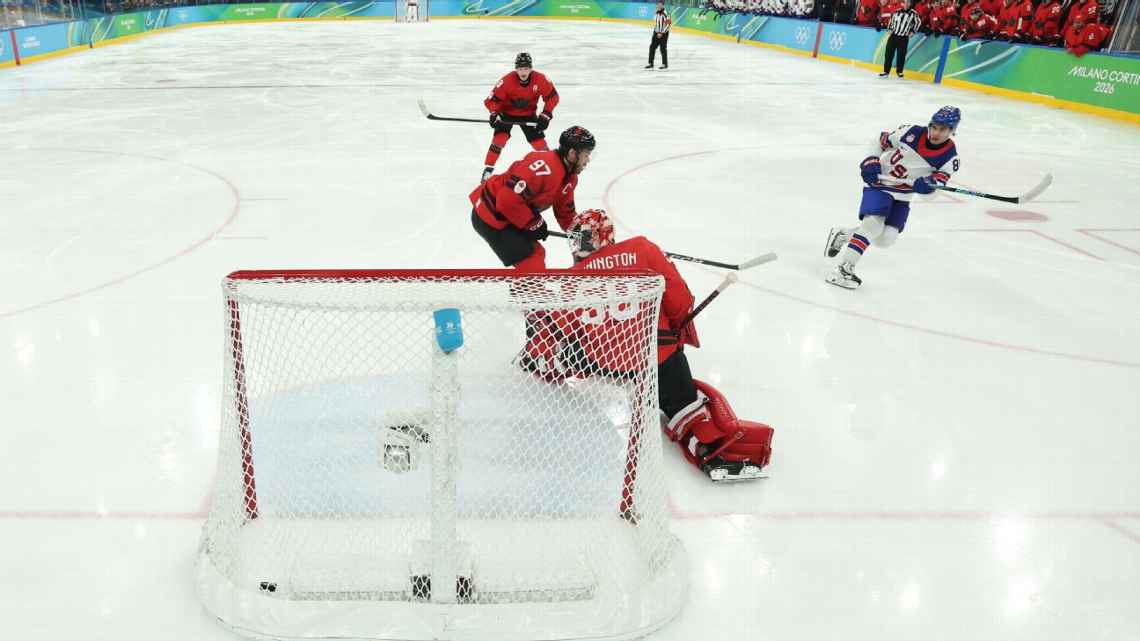
Canada’s best Barcelona impersonation wasn’t enough
Jack Hughes scores gold medal game winner in overtime
It was a week that will live in U.S. hockey lore, not because the stars aligned in some cosmic upset, but because of the beautiful, maddening, unpredictable alchemy that is Olympic ice hockey.
Canada came into that gold-medal game looking every bit the favorite. From the drop of the puck they looked like the better team — faster in transition, more precise on the breakout, more creative in the offensive zone. But in hockey, just as in football, Canada’s speed and beauty of their game – suffocating forechecking, crisp line changes, immaculate puck control – is reminiscent of how FC Barcelona dominate teams.
But just like Barcelona at their peak, you can be beautiful without winning. In the Olympic hockey tournament just as in the Champions League, aesthetics can enthrall, it can fascinate, but in the end it isn’t always triumphant.
Because in hockey, unlike almost any other sport, a hot goaltender can win a game almost by himself. And on this night in Milan’s Santagiulia arena, lightning struck between the pipes for the United States.
For 46 years the U.S. had waited for this moment. Forty-six years since a men’s hockey team had stood atop the Olympic podium. But unlike 1980 — when amateurs toppled professionals and hearts soared in disbelief — this time the roster was stacked with NHL players, battle-tested pros who make their living on the frozen chessboard. So while the drought was long, the result wasn’t quite as seismic as that earlier miracle. This was heavyweights trading blows, not college upstart kids shocking the world.
Despite trailing for most of two periods, Canada was the superior team. They controlled the tempo like a possession-obsessed soccer side, carving the ice with patience and precision. The Canadians cycled the puck, trapped defenders in their own zone, and skated with the confidence of a unit accustomed to dictating every inch. Yet they trailed after just 6 minutes when Matt Boldy of the Minnesota Wild split two Canadian defenders at the blue line by lifting the puck into the air (a very inventive move) and rushing in on the goaltender before scoring a nice goal.
After the goal, the Americans, by contrast, were the counter-attack specialists. Not by choice but by necessity. When you play the Canada’s of the game, you can’t often play on the offensive. The Canadians are so good that they force you to play the way the US did: they defended deep, clogged the neutral zone, and waited. Waited for Canadian mistakes, waited for seams to open, waited for their moment to strike. This was tactical pragmatism at its best — the hockey equivalent of a side that absorbs wave after wave before springing forward on counter-attacks with ruthless efficiency. It wasn’t aesthetic dominance; it was structural resistance.
The lead lasted late into the second period, when Canada’s Cale Makar blasted a low hard shot into the far post. The Canadian pressure finally paid off.
That was the only goal US goalie Connor Hellebuyck would concede.
From the first period to the dying seconds, he kept Canada at bay with saves that felt increasingly improbable. Midway through the opening frame, with traffic crowding his crease, he flashed the left pad to deny a backdoor tap-in that had half the arena rising in anticipation. Early in the second, he stared down a clean breakaway — gloves low, shoulders square — and snatched a rising wrist shot out of the air as if plucking it from a shelf. And in the third, protecting a one-goal lead, he lunged post-to-post to stone a one-timer on the power play, the puck ricocheting off his blocker and harmlessly into the corner as the Canadian bench threw its collective head back in disbelief.
He didn’t just stop the puck — he stole certainty. Every save bent the emotional arc of the game. Every denial tightened the pressure on the skaters in red and white. Canada kept pushing, kept probing, kept playing like the better team. But the crease had become a locked door.
With the game deadlocked at 1, overtime ensued. There is no better spectacle than he Olympic hockey overtime period, when spaces are enlarged by having 2 less skaters. It is a spectacle to watch, a free-flowing exposition of speed and moves unhindered by excessive physicality. It’s too bad it doesn’t last very long most of the time. Such is the skill of the players that the advantage always goes to the offense.
The extra period lasted only a minute and 41 seconds. Connor McDavid, considered by many the finest hockey player in the world (he routinely wins all of the skills competitions and has been the NHL’s leading scorer for the past five years), went in and got a shot on goal, where Hellebuyck stymied him. The US countered, as they had all night, and ended up with a 3-1 break after one of the Canadian players gambled at the US blue line trying to steal the puck. Moments later, Jack Hughes, all alone on the left side, fired a wicket shot past Canada’s Jordan Binnington.
In most sports, the MVP is a scorer. In hockey, sometimes the MVP is the last line of defense — the masked figure who can warp probability for sixty minutes. And on this night, the best player on the ice wore American colors.
Canada may have been superior across the sheet — in possession, in territorial play, in sustained attack. But hockey uniquely allows one transcendent performance in goal to outweigh all of that. The position carries disproportionate gravity; when a netminder ascends into that rarefied zone, the entire geometry of the sport shifts.
So when the final horn sounded and the Americans celebrated gold, it wasn’t theft. It wasn’t fortune smiling blindly. It was a deserved victory anchored by the single most dominant force in the game.
Because in ice hockey, if the best player on the ice is your goalie, that fact alone can be everything.
Loses 7-6 on aggregate in Champions League Semifinal to Inter Milan
Beats Real Madrid 4-3 in the last El Clasico of La Liga.
The Champions League Leg
Socrates, Brazil’s soccer and philosopher once said about his country’s style: “Beauty comes first, Victory is secondary. What matters is joy.” Those legendary and eloquent words best describe what transpired in the two legs of Inter’s win over Barcelona in the Champions League semifinal.
Socrates’ philosophy was expressed by Inter’s coach Simone Inzaghi in another way:“I am extremely proud of the performance my squad has put in, because tonight we faced one of the most offensive and beautiful teams in the world.”
From whatever perspective you viewed this game, as either a fan of the defeated Barcelona team espousing Socrates, or as a fan of the victorious Inter Milan side who must have held their breath the entire time and come away delighted at a victory that they probably shouldn’t have attained, one thing is abundantly clear: these two legs will go down as one of the best and most entertaining in Champions League history. The two matches were not only dramatic to witness, they were also beautiful to watch.
The sheer number of goals, lead changes (and their accompanying momentum swings and dramatic turns) evinced a drama that is not often seen at the latter stages of Champions League competition, when more defensive strategies tend to rule the day. Because teams are so averse to losing, they tend to not take unnecessary risks, especially late in games that are tied, favoring advancement over anything else. Flick’s teams do not play that way. They do not betray their style; they double down on it. Because they do not ever betray their style, their defensive high-line persists, and they tend to also give up a lot of goals. Simply put, Flick’s mantra is we will outscore you.
While this strategy has worked for Barca all season long, in the Champions League return leg, Inter were up to the task. In a see-saw battle (Inter were up 2-0, Barca stormed back to lead 3-2, Inter upped Barcelona with 2 unanswered goals for the final 4-3), Barcelona were not content with managing their 3-2 advantaged and instead continued to insist on a 4th instead of just defending, and in the depths of injury time, were stunned by an improbable and unbelievably highly skilled goal from Inter’s center back. The Milan defender, Francisco Acerbi had scored all of 2 goals in 37 appearances in the Champions League, but in the 93rd minute his sublime redirection of fast moving cross into the box (with his wrong foot no less) just eluded Czesny left hand for the 3-3 equalizer that would send the game into extra time. Drama this good can only be conceived in the writing room. The surreal goal gave Inter the momentum and they didn’t relinquish it. In extra time, Inter scored a very Barca like goal, pinging the ball inside of the penalty box with stunning precision before one of their substitutes, Davide Frattesi received the ball and waited a slight moment before firing the ball past the Barcelona goalie. The irony of that goal must have been too much on the Barca players. While they continued to look for the tying goal that would take them to penalty kicks, one couldn’t help but observe how tired, both physically and emotionally, the Barcelona players were at that point.
Inter had somehow flipped the script on Barcelona and that led them to the Champions League final against PSG, a team, curiously enough, that plays a style very similar to Barcelona.
Barcelona triumphs 3-2 in extra time of Copa del Rey Final
It doesn’t matter what year it is played, how each team is faring or the makeup of the rosters of each team. Because of its nature and position as the greatest darby in the Spanish league, if not one of the best rivalries in world club football, El Clasico always produces a great viewing spectacle. The players understand that this is one of the most important games they will play in a given year, and the only other more important ones are games against the same rival that may occur in other competitions, whether that is La Copa, or La Liga, or Champions League.
The best illustration of this occurred in 2011, when In a single 18-day period, Real Madrid and Barcelona played four El Clásico matchups. These included one La Liga game, a Copa del Rey final, and two legs of the Champions League semi-finals. This was considered a unique and intense period in the rivalry’s history.
Watching Barcelona play Real Madrid not only produces great drama on the pitch, but what it always reveals, without failure, is the distinct philosophies of the two great Spanish clubs: Barca’s legendary possession football coupled with a enhanced version of line breaking passes (Flick’s tweak) versus Real Madrid’s stout defense, lightning fast counter-attacks, and mastery in set pieces. Barcelona’s commitment to its philosophy of creating great players that learn its style to Real’s philosophy of buying the best and integrating them into a whole. The clash of styles is as classic as the rivalry itself; it’s what gives the rivalry its special meaning.
Of course, as this year has now proven, when Barcelona is loaded with generational talent, no other team in the world can match the style that they invented and continue to perfect. (Consider that if Barcelona played Man City, the team that most recently is the best imitator of the Barcelona school, mostly because its coach Pep Guardiola was reared in it, I would fully expect Barca to have an edge in possession, albeit a small one.) And when they are on top of their game, Barcelona is a difficult club to beat.
Barcelona’s record against their rivals this year may be unparalleled in history. In an early meeting in October 2024, Barcelona ripped the Merengues 4-0 at the Bernabeu, a win which had followed a similar demolition of Bayern Munich (4-1) in a Champions League game just days before. In January, in Jeddah Saudi Arabia, Mbappe got Real Madrid off to a fast start but in the end it was another resounding win (5-2) for the Barcelona squad. When I first started watching soccer, when I lived in Spain in 1974, Barcelona, led by Johan Cruyff, crushed Real Madrid 5-0 in the Spanish capital. (That game and season marked the start of the modern day Barcelona team that we know today.) But more than one lopsided victories between the two titans in a single season are rare.
Early on in this encounter it was obvious that the aforementioned patterns would prevail. Barcelona would have the ball and Real would sit back in their defensive block and counter with lightning speed. That’s been the time tested strategy against Barcelona, mostly because teams don’t really have any other choice. As good as Real look against other teams, in the sense that they can outpossess other teams and force them to counter, they can never seem to do this against teams that practice the Barcelona style, whether that is the Blaugrana itself, or other incarnations of that style such as Man City or even Arsenal (the team that just recently vanquished them in Champions League).
This game was intense from the beginning with Barca getting the lead 1-0 before Real scored two unanswered, and then Barca scoring the last 2 to finally win it. Three lead changes with a final goal in overtime was as much as any fan could ask for.
In the first half it was all Barcelona possession and Courtois making big saves, one of his finest on a header from Kounde. But in the 27th minute, Yamal proved why he’s the most lethal player in world football. Even with three men guarding him on the right side of the box, he still crossed it to Pedri just outside of the box, and the passing genius showed off his finishing touch with a shot that no goalie in the world was going to stop, not even Courtois.
Real’s best moments, and a sign of things to come, came in the 40th minute when Bellingham scored but it was annulled because he was offside. In the dying moments, Vini finally having found his groove, charged in on goal with speed before being fouled. The referee initially signalled a PK but it wa subsequently overruled by an offside.
In the second half, Vini had two shots early on forcing Szczęsny into his first two saves. Mbappe’s introduction into the second half levelled this match as Real created 5 chances in 10 minutes. On one of those Mbappe dribbled three Barca players and was fouled by DeJong, who grabbed his arm to gain a tactical foul rather than letting the Frenchman blow past the Barca defesne. Mbappe finished this off with a low hard free kick that bounced off the left post for the equalizing goal.
In the 74th minute, the perfect illustration of the stylistic differences materialized. As Barca pinged the ball from side to side looking for the perfect chance, Madrid stole the ball and mounted a 70m counter attack with Vini generating another scoring chance. While that didn’t go in, Tchouameni scored on the subsequent header from a perfect Guler corner at 77’. It was the 6th corner of the half for Real Madrid.
In the 83rd minute, Ferran latched on to a perfectly weighted ball from Yamal (the kid also has prodigious passing talent) enabled him to beat both Ruddiger and Courtois to level the score, and to send the game into overtime.
A perfect example of Barca’s more advanced passing occurred in the second half when they made two perfect 30-40 m passes to Raphinha that broke Real’s defense apart. Raphina put both balls wide (it wasn’t his best game) but the constant pressure exerted on Madrid paid off at the end.
With the score tied at 2-2 in extra time and PK’s looming, It was an uncharacteristic mistake from Luka Modric that gave Kounde his chance to shine. A clearing pass from deep in defense right into the middle of the field was intercepted by Kounde, who dribbled it once before striking the ball perfectly with a low hard shot to Courtois’ right and into the corner of the net. Even the best eventually succumb to the suffocating Barcelona press.
Although Barca always produce a great stream of talent, Barcelona’s current homebrewed stars Yamal, Pedri, Gavi, Cubarsi along with imports Raphina, Lewandoski, DeJong (from Ajax which is a similar academy system to Barcelona due mostly to Cruyff’s work in building both) and Ferran constitute a side that may match the great Barcelona teams of 2008-2011.
Starting off Barcelona’s most talented youngster in a generation, Lamine Yamal, who at only 17, looks like the second coming of Messi. A player able to break down opposing defenders at will with incredible footwork, speed, and a finishing touch that gets more polished with every minute he plays. Lamine himself may not like the comparisons, but they are now not only becoming irresistible but also more plausible. Pedri is like a hybrid of Iniesta, Xavi and Busquets, a player with the uncanny ability, characteristic of all the Masia academy players, to slow the game down, yet explosive enough to dribble past defenders and then deliver the most perfectly weighted passes into space. What made Pedri especially good this year was the number of defensive line breaking passes he made to lead La Liga. (But Pedri is not alone in midfield. Both Casado and DeJong also are great at line breaking passes. The Barca trio is in the top 4 of most line breaking passes in La Liga, with the bulk of their breaks in the second line category.) All of this rich midfield play has enabled Barca’s wingers Raphinha and especially Yamal to be on the receiving end of these perfect spot passes. Ferran and Lewandoski are perfect 9’s, which are very suited to playing Hanzi Flick’s more direct style (i.e. longer and more line breaking passes) than Barcelona has played before since it gives them better finishing opportunities.
With one trophy down, Barcelona are now looking for the treble. La Liga title is within reach as is the Champions League title. With the team that Barcelona has and the way they have been wielding their style upon their opponents, anything is possible.
Arsenal defeats Real Madrid 3-0 in the first leg of Champions quarterfinals.
Return Leg
Let’s start by making a bold prediction. Real Madrid, down by 3 goals to a very good Arsenal team, a team that is second in the world’s toughest league, a team led by Spaniard Mikel Arteta, a team that plays an elegant style of football reminiscent of the Barcelona glory teams from 2008-2011, will make an astonishing comeback and defeat the Gunners before it is all said and done and advance to the semi-finals.
This prediction is based on both qualitative and quantitative analysis. The quantitative part of the equation is based on the fact that Real Madrid have won this competition 15 times and Arsenal have never won, and also because Real has proven itself, over the last decade, to be a Premier League vanquisher (Liverpool twice, Man City twice). Real Madrid have played in 502 UCL games and won 302 with 85 draws and 112 losses, so they only lose 22% of the time. I was unable to find statistics for how many home games Real has lost in this competition but extrapolating from the numbers above, it would seem fair to say that Real has probably only lost at home 50 times in 55 years of competition, or only about 1 a year. So their chances of winning at home are very high again.
The qualitative side is simple. It is not based on any tactical analysis and is simply a gut feel. It is based on the fact that Real Madrid are the best team in the history of club soccer, the most successful in this particular competition, and also because the return leg is in their home stadium, a place where they rarely lose in Champions League (see above). Real vanquished Liverpool in a somewhat similar manner in 2023 when it scored 5 straight goals after the Reds took a 2-0 nil lead in the first 15 minutes in the first leg at Anfield. Although the circumstances are somewhat different here, these Madrid players know what they are capable of simply because they have done it recently before (see video highlights at bottom).
This squad, after having been embarrassed in London, will be more than ready in the return leg. Winning championships is in the DNA of this team; their success in this tournament is simply unsurpassed. When a player signs on to play for the Merengues, they know the history, they know the height of expectations and responsibility placed on them, and most often than not, the players rise to the challenge, no matter the obstacle. The fans, accustomed to Real’s winning pedigree, always create an extremely hostile environment to away teams. The atmosphere next Tuesday at the Bernabeu should be as electric as ever given the obstacle the Merengues are facing. By the time Real get that first goal, it will be increasingly difficult for them to withstand the tsunami that is about to hit them. The first 15 minutes will be key. We will find out very soon how good the Gunners game travels.
First Leg
Arsenal truly dominated this game, creating numerous chances and forcing numerous saves from Courtois to keep the game scoreless in the first half. Arsenal had 69% possession in the first 15 minutes of the game.
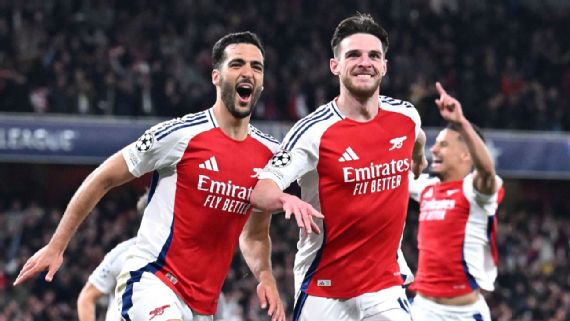
The second half explosion was triggered by Declan Rice, a solid midfield player who had never scored a goal from a free kick, yet managed to score two in a 15 minute span and made history as the first player to score two set pieces in a single Champions League game. (One has to wonder why a player who never has scored off a free kick got the chance to do it not only once but twice. Arteta must have seen or sensed something during the practice sessions). It is important to note that, on the first kick, Courtois made the mistake of only placing 4 players on the wall and Rice was able to curve the ball around the limited wall, the ball bending viciously and seeming to accelerate around the last man as if it were a rocket gaining speed from the gravitational pull of a planet. The second kick was your classic upper corner “postage stamp” goal and was simply unstoppable. My favorite goal was actually Mikel Merino’s sublime finish on a pullback cross from Leandro Trossard. The technical level of that goal was simply amazing. The pace and placement of the ball was of the highest level. Most often than not, those shots go either wide (skewed by too much placement) or high (too much power).
Mike Arteta described this game as “the biggest of his managerial career” and his team delivered. But that’s the beauty of the Champions League format. One game isn’t enough to finish the job. You have to perform at your highest level in two games against the best clubs in the world. The second leg will now surely surmount the first as the most important. If Arsenal can win at Madrid, they will truly have earned it.
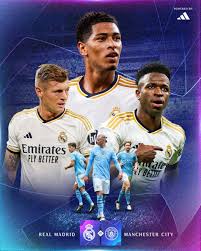
Manchester City against Real Madrid has now become, in the infamous words of ESPN, an “instant classic”, or for those more familiar with the English terminology, a Champions League “darby” of sorts. These two teams have squared off the past 3 years in the Champions League in two-legged affairs. The budding rivalry has been elevated to the highest level because not only are these two teams amongst the top clubs in the world, but because the games that they have played have themselves been of the best technical quality, highly entertaining, and quite dramatic. But what has become the most fascinating facet has been the clash of two radically different football philosophies.
Pep Guardiola’s City is the third-generation or version of the style first introduced in Guardiola’s early years at Barcelona, a team that played a style commonly known then and now as tiki-taka (The Spanish team of the 2008-2012 era, which was heavily populated with Barca players, also was renowned and credited with playing that but the style was nascent in the Cruyff Barcelona Academy system). Guardiola then took that system to Bayern Munich in the early 2010’s and finally to City starting in 2016. Guardiola is known to have distilled tiki-taka into its simplest formula:
“In the world of football, there is only one secret: I’ve got the ball or I haven’t.”
Guardiola’s teams throughout the years have perfected the left-hand part of the equation in his succinct statement to the point that each team, each generation, is substantially better at the art of possession football than its predecessor. They have the ball the most of any team in the modern era and they are able to do that against any team, from the bottom feeders of the EPL to the very best teams of all of Europe. One of the key factors in this strategy is the ability to win the ball back quickly once possession is lost. This has the effect of not only demoralizing the opposition but more importantly, inducing huge levels of physical and mental fatigue as it forces them to play defense not only for a majority of the game but also for long stretches of time (i.e. minutes) during the game. Guardiola’s teams vaunted high press defensive techniques are just as important of an ingredient to the success of the style, albeit not as aesthetically pleasing, and hence not as glorified.
So what to do if you’re up against a team of City’s caliber ? They are going to have the ball the majority of the time so your only option is to low-press, which is colloquially known as “parking the bus.” It is not a tactic that teams wish to employ (well unless you’re Italian and love catenaccio). It is a tactic that is forced upon them by the quality of the opposition. City imposes its will on you to the point that this becomes your only resource.
But as with any tactic there is a counter tactic. City’s ever increasing dominance of possession over the years has forced teams to retrench farther and farther back into their own goal, thus shrinking the available field of play. Teams used to play defense in their own half, a distant luxury as City presses further and further upfield with their vaunted possession; nowadays it is common for defenses to pack inside of a 30 to 35 yard box from their own goal-line. This counter tactic has now forced City to try to create offense in ever shrinking real estate than ever before. The other aspects of tiki-taka, the false 9 and positional play, tend to have diminishing results as the space in which you are forced to operate is reduced. When playing teams of substantially lesser abilities, which really, in this context, means a less cohesive defensive shape and the ability of its players to adhere to it, City is able to eventually break teams down and win at a high percentage.
Real’s counter was to exploit the high-press with lightning quick counter-attacks with passes over the high-press into space where one of their two speedy and highly-skilled front-runners, Vinny or Rodrygo could run onto the ball and hold it long enough while being defended by more than one player, and then find an open teammate deep in City territory to create opportunities.
Both goals were perfect examples of each team’s brilliantly planned tactics. Real, knowing that they had to score on City’s ground, got their goal early (12’). Carvajal’s long high pass went to Jude Bellingham, who controlled it deftly deep into City territory and away from the press. Bellingham initiated a passing sequence that went through Valverde, then Vinnie, before the latter’s cross found Rodrygo open in the middle, who scored on a second bite of the cherry after Ederson saved his initial shot. After that it was all City the rest of the game. City generated shot after shot (33 total), corner after corner (18 total), before Kevin DeBruyne (76’) got a hold of a weak clearance from Ruddiger, took a little subtle touch (no panic on his part) before roofing into the net.
The game, thus, had gone according to the master plan. City attacked constantly, and Madrid generated enough counters to keep the encounter honest. After DeBruyne’s goal, it seemed like Real would crack, until they didn’t. DeBruyne missed a second clear opportunity minutes after his goal that would have sealed the deal but he put it just high. Madrid survived the onslaught (48 defensive clearances !) not only during regulation but also for the extra time. Their goal, to get the game to the penalties, had been achieved.
In the six games that these two teams played over the past 3 years, Real was the perfect foil to City style. City would get goals but not in the numbers required to win outright. (The only exception to that was in the second leg at the semi-final stage in 2023 when City thumped Real by a 4-0 scoreline that was as dominant a performance that one elite team has put on another in recent memory.) In this last game, City couldn’t win in regulation and was forced to try its luck in the penalty kicks.
City’s two misses in the penalty shootout was its undoing. Madrid’s Modric was the only Merengue to miss. That slimmest of margins was the difference.
Was City the best team ? Undoubtedly. The data doesn’t lie. But Real did just enough to move on yet again. This is the sixth time that Madrid has eliminated City, twice as much as any other team.
I’m sure another chapter of this instant classic rivalry will play out again next year.
Penalty Kicks:
To the soccer aesthete, the difference between City and Real (or is it City versus any opponent ?) is a matter of style. On the one hand is possession football at its finest: the ability of a team to hold on to the ball for extended possession in compressed space, string together tens of passes per offensive possession, swing the ball around the perimeter of the defense at will, create overloads and mismatches, generate shots and corner kicks ? Or, on the other hand, is counter-attacking football more to your taste: the ability of a team to defend fiercely and then when given the chance to strike back quickly, effectively, and efficiently (i.e. create scoring chances or score outright). It is a matter of do you enjoy a team’s ability to compress footballing space, or do you enjoy a team’s ability to explode into vacant space. I personally am awestruck by the former, but enjoy and celebrate the latter.
What is going with Halland on this team ? I’ve alluded to this before, but after this game I feel even more assured that The Terminator is a misfit for this style. Before City, Halland was well known for his explosions into enemy territory, using his amazing pace and power to beat opponents and score amazing goals. In this scheme, he hardly touches the ball. He seems relegated to trying to score with his head (he did hit the crossbar once today) or cleaning up on rebounds. On a team of creators, he is the least creative of forces. If you click on the Passes Tab in the “theanalyst.com” site below, you’ll see Halland (#9) on a bubble by himself, disconnected from the rest of the team, all of whose players are connected by a full mesh of passing links.
The answer I think, in the context of what was previously stated, is that Halland is a better player when he’s exploding into empty spaces, where he can use his amazing pace and finishing ability, rather than operating in compressed spaces, where defenders are more efficient against him by being able to be more physical and better able to defend his limited dribbling ability. Hence, he’s limited to headers and cleaning up rebounds and deflections.
Messi plays in Monterrey for first competitive game in Mexico
Lionel Messi played his first competitive game on Mexican soil last night in a Concacaf Champions League Game as his Miami International team fought to stay alive in the competition in the return leg against a Monterrey team that has dominated this competition for the last decade.
It was not a good debut.
Messi missed the first leg due to injury and saw Miami relinquish a one goal lead after David Ruiz was red carded in the 60th minute. Monterrey scored two late goals to take the advantage going to their home stadium. (Away goals still count in Concacaf so Miami needed to win by a two goal margin to keep their Champions League hopes alive.)
In the 30th minute, Messi must have wondered what his goalie Drake Callender was up to when, trying to build from the very back, as is the favored tactic nowadays, he passed the ball inside his own goalie box right to Brandon Vazquez, who was high pressing him. Vazquez stuttered step after the interception, and after the goalie went to ground, easily scored for what appeared to be an insurmountable 2 goal advantage.
Messi was seen rallying the troops afterwards, trying to instill that unflappability that only the greats seem to ever have in the face of such a difficult situation. After all, Miami still only needed to score two goals to push this into the extra period. It was not an impossible task, especially given the fact that the greatest footballer known to man had 60 minutes with which to work to pull off the miracle comeback.
But this Miami team, despite the fact that Messi dragged 3 of his old compadres with him in Busquets, Alba, and Suarez, are not the same caliber team he’s used to playing with, especially since most of the old crew are all over 35 now, including the great Messi himself. And even though Leo is still playing at a high level, that of the other three has dropped, most significantly Suarez, who has definitely lost a step or two..
The other pivotal factor that made this comeback more difficult is that the opponent is the Real Madrid of Concacaf (well maybe that’s a bit of a stretch but hey any time we can give kudos to the Merengues we might as well take the opportunity), a team that has the pedigree but more importantly the supreme confidence that it can win in this competition, mostly because they have for a decade now, the opponent notwithstanding.
At the stroke of half-time, Suarez and Messi attempted to conjure the old magic. Suarez lifted a ball skillfully to Messi whose shot didn’t have the power to beat the Mexican keeper Arteaga.
In the second half, Monterrey struck again through a rocket from Berterame at the 58th to extend the aggregate advantage to three goals. By the 60th, even though Miami had 63% of the possession they had been outshot by 11-3 (7-0 on frame). In the 64th the moment where insult is added to injury arrived, as Miami again playing sloppily out of the back had the ball intercepted and Gallardo scored on an unchallenged header to take a 3-0 lead (5-1 on aggregate).
Miami got one back at the 85th when Gomez headed in a perfect ball from Messi off of a set piece. Monterrey looked like they left the foot off the pedal.
Miami’s Tata Martino came into this game proclaiming that they were trying to build something great at the club, to form a team that could challenge if not dominate in the region. But that appears to be a work in progress for the very long term. Beckham and company have their work cut out for them.
This is a team that appears to be completely star-struck on Messi and heavily dependent on him (they are 2-12 without him and 18-2 with him). The fact is that this is a very bad defensive team. They were heavily exposed in this game and in the MLS they have given up more goals than any of the top ten teams in the table. Note that none of the players Messi brought with him are defenders, with the exception of Alba, and he’s always been an offensive minder left back.
Given the MLS’s salary structure, it’s going to be hard for Miami to build a more defensively stout team given how much money the big four are making. (The team used a loophole to avoid making Suarez a Designated Player instead using part of the Total Allocation Money pool.) It’s doubtful, in my opinion, that the club will continue to stay near the top of the Easter conference this year.
There will be challenges come summer and fall. The weather is hotter than in the European seasons and the travel is more arduous. And for Copa America, which will run for three weeks, Miami will be without Messi. And in fall, when World Cup qualifying resumes, Messi will miss additional games. As an aside, for what it’s worth, I believe that one of Messi’s overarching reasons to sign with Miami instead of a Saudi or Chinese team was to lessen the travel for his duties with Argentina’s national team. To my mind, he’s clearly not satisfied with the number of major trophies he has won with the Albiceleste. Trips from Miami to South America are fairly short as compared with those from Europe or Asia. Winning a second Copa America and at least qualifying for his 5th World Cup (and possibly winning another title) are very achievable goals for him and Argentina. On the club side, Miami’s record without him isn’t going to improve dramatically. This was a bad team before he arrived and they will be bad when he’s not in. So maybe that’s not where his priorities lie.
For MLS however, it’s an understatement to say that their interest is that Miami do well; it would be a very bad look if the world’s best player, the recently anointed World Cup champion, languishes on a bad team.
It’s a more glaring understatement to say that the star appeal is still a huge force. Messi’s draw is such that Miami’s next game in Kansas City has been moved to Arrowhead Stadium, whose capacity dwarfs that of Sporting KC’s home base at Children’s Mercy Park. If Miami fare well in the league, this loss will be forgotten. But if they don’t, if the team’s fortunes head south, there’s no telling how interested Messi will stay or if he’ll stay at all past his two and half year contract.
At the end, the Mexican fans booed Messi at every touch of the ball. At least they didn’t chant the homophobic chant that Mexican fans have become notoriously associated with and that has caused the fan base and the Mexican Federation disgrace worldwide.
Lionel’s first competitive game in Mexico didn’t end well but Messi, being Messi, will be just fine.
Two legendary clubs face off again in the Round of 8 of the Champions League
It is fair to say that the Champions League doesn’t employ bracketology. For the knockout phase of the tournament or single elimination, starting with the Round of 16 clubs are not seeded and then matched up against each other. Instead the matchups are based on a random draw. The same is done for the Round of 8.
If an NCAA basketball seeding type system was employed, one cannot argue that City and Real would be seeded #1 and #2 respectively and would be put on opposite sides of the bracket and would not be playing each other this early. Instead, the draw system now has given us what surely could be, or should be, the Championship game itself but at the quarterfinal stage instead. This assumes that each team would win out to reach the final stage. Given the recent records of these teams (they’ve only lost to each other in the knock-out phase the past two years – City winning in 2023 and Real in 2022), it is very feasible that this would happen.
As written before, Real Madrid is the winningest club in soccer history. They have amassed more trophies than anyone else. Manchester City, on the other hand, now led by who arguably could be called one of the greatest managers of all time, are so good now that serious debate can now be had about whether this is the greatest soccer team ever assembled.
City won the trophy last year, in a run that included a serious manhandling of the Merengues at the semi-final stage, where City won 5-1 aggregate after thumping Real 4-0 on the return leg, and where they were never seriously threatened. City also won the EPL and the FA Cup to complete the legendary treble. They are on track to repeat that feat this year and a back-to-back treble has never been achieved before.
So the stage was set for the clash of the Titans, the new classic European rivalry.
The game at the Bernabeu started horribly for Real as Silva scored off a free kick in the second minute, surprising the Real goalie with a hard low shot to Kepa’s right, where he should have been better positioned.. But unlike the matchup last year, when Real Madrid just could not get enough possession of the ball to initiate their lethal counter-attacks with either of their Brazilian speedsters Vinnie or Rodrygo, this game was different. Able to have at least 40% possession in the first half, Real scored two goals, one an own goal after Diaz deflected Kamavinga’s long range shot, and the other through a long ball from Vinnie to Rodrygo down the left flank, where the latter outraced Akanji to the ball before he was able to put the breaks on, let Akanji fly past him, and then scored with a simple little kick past the Ortega Moreno (one wonders if Ederson would have done better here.)
Two important reasons that allowed Madrid to gain more possession this game than the last were: Tony Kroos’ man marking of Phil Foden and Kamavinga’s physical presence in the midfield. Kroos shadowed Foden all over the pitch, not allowing him to get untracked during a year where Foden has clearly been one of City’s most lethal scoring options. The choice of Kroos is unusual tactic given the difference in age but Kroos has had a resurgence of late, even being recalled to Germany’s starting lineup. On a side note, Kroos has been one of my favorite Madrid’s players in the past five years. For someone his age to still be able to perform at this level is simply amazing. He is an elegant player who makes things look easy, rarely makes mistakes, and plays better positional defense than one would think a player his age could do. On the other hand, Kamavinga won the battle of midfield, making it difficult for both Foden and Rodri to operate.
Foden finally freed himself of Kroos and unleashed a rocket into the upper left-hand corner of the net in the 65th minute. With Kamaving just a second late, Foden found himself wide open in the middle just outside of the 18 yard box before unleashing his shot. Just 5 minutes later, Guardiol scored on a rocket of his own. Grealish, who had up to this point, done very little, attracted three defenders on the left flank using his exquisite control before passing it to Guardiol, who touched it what seemed to be too far away, but with nobody but Kroos closing him down, still had enough open space to unleash the lethal shot.
Real Madrid, however, was not to be outdone. Modric entered the game for Kroos and quickly put his customary stamp on the game. After a Kamavinga interception in midfield, Modric carried the ball through the center of the field before laying it off to Vinnie, who instead of doing what he does nine of ten times – dribble into the area to his left, cutting it back to his right and shooting — crossed the ball with his left foot to Valverde, who hit the ball on the volley into the corner of the City goal just as one would dream it (hit the ball from whence it comes as they say). It was the third stupendous goal, a third rocket, of this magnificent match.
It’s unfortunate that this spectacular game couldn’t have been the Final. On the plus side, we get to see a second leg, which promises to be just as spectacular as this one, given all that is at stake.
Notes:
City unbeaten in last 60 games that Rodri started.
It is surprising to note how little Halland touches the ball on this team, one that is known for its passes that number in the hundreds per game. He did have a couple of good defensive plays against Vinnie in the second half, but as far as an offensive threat, he was invisible.
How does Modric keep playing at such a high level ? His presence into the game not only energized Real Madrid, it also flipped the possession into the Merengue’s favor. Not even City’s vaunted press could take the ball off of his feet. He is a truly sensational player.
Scoring:
2’: Bernardo Silva surprises the Real Madrid keeper from a free kick.
12’: Kamavinga’s shot deflects off of Ruben Diaz for a goal.
14’: Rodrygo scores with a simple little kick after outracing the City right back Akanji down the right flank. Walker’s absence is noticeable.
The Merengues team beat the Reds for the 7th straight time in Champions League
How else to describe Real Madrid’s utter dismantling of Liverpool (at Anfield no less) and continuing domination of the Reds than to resort to two well worn soccer cliches: a) The 2-0 lead is the most dangerous in football and b) it’s not how you start the game but how you finish that counts.
Liverpool started off to a flying start, deploying their customary and speedy high press. Minutes into the game, as Liverpool’s forward Dario Nunez made a diagonal run in the box, and a microsecond before the ball arrived, he lept into the air pushing off of his left leg before flicking Mo Salah’s cross elegantly with his trailing right foot. The cheeky finish skipped past a stunned Courtois for the 1-0 lead. Before the 15 minute mark, the usually unflappable Courtois made an unaccustomed gaffe while handling a back pass. As he tried to control the high bouncing ball, it went off of his knee straight to the onrushing Salah, who made no mistake and fired it past Courtois for the 2-0 goal lead.
Liverpool had their flying start. The fans at the KOP were fired up. Surely this was the beginning that coach Jurgen Klopp had hoped for.
But what makes Real Madrid the great club that it is, the club that has won the most European championship trophies of all time (20 including 14 Champions), the most trophies of all time (97), is their utter unflappability. This is a team that is not faced by a deficit of any kind, at any stage. The most recent evidence of that resiliency was their comeback against Manchester City in last year’s semi-finals, when they overcame an early deficit to City in the first leg to crawl back within one goal before finishing off Pep’s fine team in the second leg.
Vinicius Jr. celebrates his first goal.
On this night they were playing with heavy hearts as one of the club’s greats,Amancio, had passed on the day previous to the match. After a one minute of silence observance before kickoff, the Merengues did not appear to be fully concentrated on the game at hand. But all of that changed once they started to get possession, once Liverpool handed them the ball, seemingly content with the 2-0 lead (see point a) above). In the 21s minute Vinny “Flash” Jr. scored against his Brazilian teammate Alison with a beautiful curling shot to the far post. Taking the ball on the left, Vinny used his signature exquisite control and explosiveness to free himself from multiple defenders in a tight space at the corner of the box before unleashing the kick that would spark the comeback. Vinny created the yard of space seemingly out of nothing and that’s all this incredible player ever needs.
Liverpool, still in the game, almost scored five minutes later but Darwin Nunez was denied at the goal line by Carvajal. A couple of moments later, Vinny almost scored from the same place as his first goal, but this time Alison made a fine diving save to deny his countryman.
Fifteen minutes later, Vinny would again score off of a mistake by Alison. Fielding a back pass and also feeling the pressure from his fellow Brazilian Vinicius, Alison opted for a hard clearance to the right straight into the path of the pressing Real Madrid player instead of either cutting the ball back hard to his left (where he would have easily faked out Vinicius, who had turned his back) or simply booting it hard to his left. Instead the poorly kicked clearance bounced off of Viny’s leg and straight into the goal for the 2-2 tie. Jurgen Klopp could be seen clapping, as if urging his team to not lose its head, still enthusiastic about his team’s chances.
Madrid almost made it 3-2 at the stroke of halftime with Courtois throwing a 40 yard pass to Valverde who found Vinicius who crossed into Rodrygo. Only Andy Robertson’s fine diving clearance saved the day. The play was indicative of Madrid’s never say die attitude and also of their willingness to stick a dagger into an opponent at any point in the game. Having come back from down 0-2 to tie the game, a third goal at the end of the half would have been devastating to Liverpool. That, unfortunately for the Liverpool faithful, would occur sooner than they would have hoped.
If Liverpool had the dream start at the beginning of the game, Madrid turned the tables in the second half. The Merengues won a free kick from the left-edge of the box in the 47th minute and as Modric stood poised to take it, Eder Militao ran across the goalie box and met Luka‘s perfectly placed kick. Not a single Liverpool defender tracked him and Militao was left all alone to drill the ball powerfully into the back of the net. As the Madrid players celebrated in utter jubilation by the corner flag, the Liverpool players looked on the scene stunned. Alison and van Dijk had a look of incredulity. Klopp was no longer clapping; he just looked nervous and worried.
Just 8 minutes later, Real Madrid recovered the ball at the edge of Liverpool’s box. Benzema and Vinicius worked a beautiful 1-2 in a tight space. As Benzema received the return pass he fired a shot that deflected off of Joe Gomez and into the back of the net. In the 67th minute, after an errant pass in the midfield, Modric picked off the ball and dribbled the ball upfield at high speed, eluding and shaking off would-be defenders before passing it ahead to Vinicius, who after attracting two defenders, pushed it ahead to Benzema. The Frenchman coolly eluded the onrushing Alison and placed the ball into the back of the net for the Merengue’s fifth unanswered goal.
One final observation of this play is warranted. Liverpool’s 18 year old midfielder, Stefan Bajčetić, was victimized on this play by Modric. To Bajčetić’s defense, he didn’t lose the ball in midfield to Modric (that was Fabhino), but it was him who had the enviable job of trying to stop the player who is almost 20 years his senior. Unable to stop him in mid-run (Modric shook him off like an American Football running back using a stiff-arm), he trailed the play for a bit as the other Liverpool defenders were mesmerized by the passing and movement of Real’s troika but after all of the work he had put in the game, he gave up on the play at the very end. He could have tried to stop Benzema but he simply watched as Karem finished the play. I’m sure this will not go unnoticed by Klopp, but the young Bajčetić is the least likely player to shoulder blame. Gomez, Fabinho and van Dijk also had terrible performances.
Liverpool’s defense looked haphazard and disorganized the entire second half, as if they were chasing shadows in white shirts. At the end, when Benzema’s shot had struck the back of the net, Liverpool’s players looked on helplessly and with the knowledge that their Champion’s League run had ended on this night after being vanquished by the winningest soccer club team of all time.
Notes:
Real Madrid has won 7 straight UCL games against Liverpool, dating back to 2014. This includes two UCL finals.
On paper, Real Madrid is the the team with the most trophies ever (see the reference below), but in my opinion, they are not the greatest club of all time. That distinction belongs to Barcelona. The reasons why I believe this will be addressed in a future post.
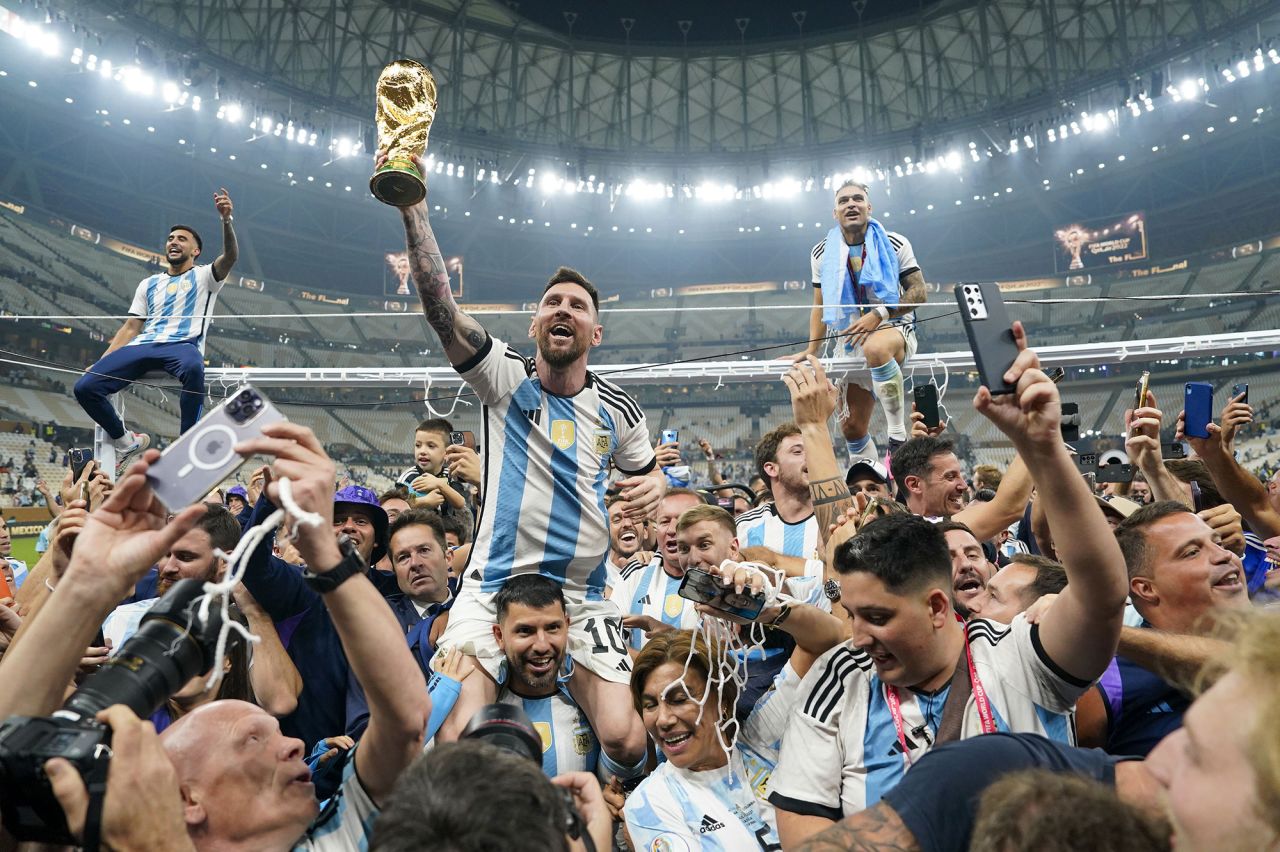
On the stage in the middle of the field of the golden Lusail stadium, Argentina’s Lionel Andres Messi finally lifted his first World Cup, the only trophy to have eluded him in his long and glorious career. Throughout this tournament, Messi played the best football of his life. The game was his crowning achievement. The numerous youth games that his grandmother took him to, hundreds of games with Barcelona, the couple of seasons at Paris St. Germain, all of the international matches, had prepared him to be able to perform at the highest level in soccer’s most important competition.
For the final celebration, the lifting of the Jules Rimet Trophy, in the middle with all his teammates, Messi wore a bisht, a traditional Arab robe that was given to him by the Qatari Emir. The bisht is made of camel hair and goat fur and is given to those as a high sign of respect in the Arabic culture. As he has proven throughout his career, and finally capped off with a World Cup triumph, Messi can no longer be denied the title as the greatest soccer player ever to play the game.
Messi hoists the World Cup Trophy
As if everything he had already accomplished wasn’t enough: all of those Champions Leagues, La Liga titles and cups, multiple Ballon D’Ors, the Copa America, all of the wonderful and magical goals. The World Cup was missing from his trophy case. His nearly 20 year professional run is unmatched. With that void filled, is it fair to speculate that this man’s career may never be duplicated ?
The championship game in which Messi emerged triumphant was a glorious spectacle. Championship games are supposed to be competitive, back and forth affairs, featuring multiple lead changes, drama aplenty. But they don’t often deliver on that promise. This one did, it lived up to the hype, the battle of the two superstar club teammates, and in the end it wasn’t decided until the very last kick.
For the first 70 minutes, Argentina were in complete control. From the offset they were the more aggressive team, firmly planted on the ground, willing to attack France and deny them any opportunities to do the same. The incessant approaches finally paid fruit in the 21st minute as Angel DiMaria, who had made various incursions on the left flank, got Dembele to bite on a fake to the end-line and cut the ball back and then penetrated into the box. Once past Dembele, two French defenders awaited DiMaria’s approach. Dembele’s unnecessary if slight push from behind drew a penalty. Messi calmly converted the PK (his fifth of six in the Cup) and Argentina were off to a flying start.
France attempted to respond but made few incursions into the Argentinian zone. The game reverted to form as Argentina continued their dominance. The French, a team who doesn’t usually press high, attempted to do so in the 35th minute and forced a turnover. On the throw-in, Mbappe took it out of the air and accelerated into the box, but the ball got away from him a bit and Nahuel Molina tapped it back to Argentinas keeper Emiliano Martinez.
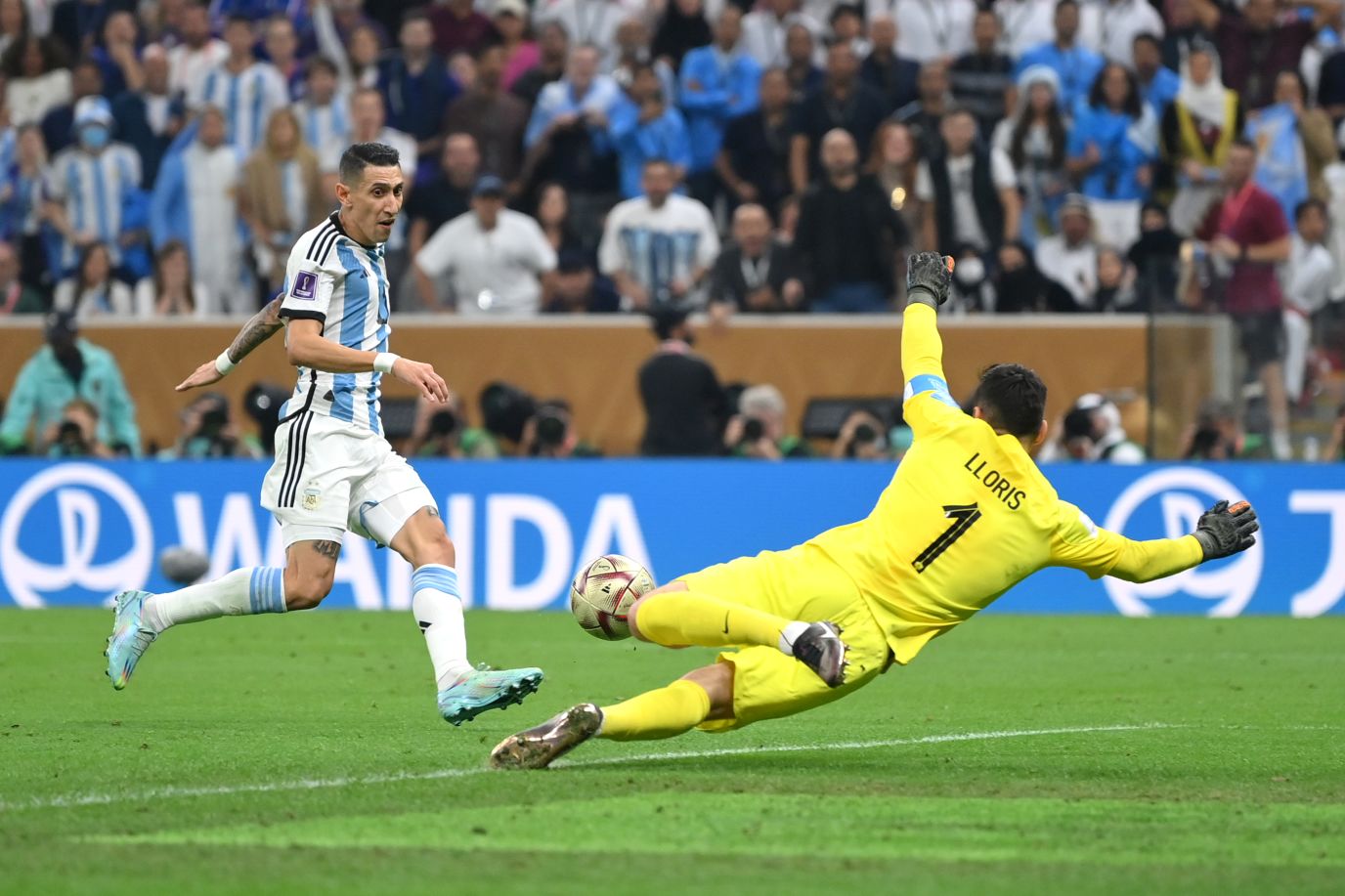
In the subsequent sequence, Argentina struck again on a classically constructed counter attack. Argentina’s center back Romero intercepted a French pass and passed it ahead to Mac Allister, who quickly one touched it to Messi and then started a sprint up the field. Messi had drifted back slightly in his inimitable slow trot to his own half just below the center circle. As he received the ball, Messi quickly popped the ball up and then, in one motion, flicked a pass to Julian Alvarez with the same foot to the right wing. Alvarez took one short dribble and slotted it forward to the streaking Mac Allister. Mac Allister’s dribble took him wide to the right away from the French goal and had the effect of both penetrating into the French zone and attracting two defenders to him. His subsequent no-look cross found Angel Di Maria all alone to Lloris’ right. DiMaria first-timed the ball into the ground and that slight bounce eluded the French goalie’s left leg. It’s interesting to note that the two forwards initiated this play in their own half, far away from goal, and a defensive midfielder and winger finished it off. This inverted offensive attack was proof of the talent and ability of the Argentinian team at all positions. It also proved that Messi, as the initial creator of the play, can be lethal from anywhere on the field.
Argentina’s beautiful team goal (5 passes, 6 players) spanned 90 yards and took less than 10 seconds. It’s hard to pinpoint which of the elements of this counter are more aesthetically beautiful: Mac Allister’s pass and sprint forward, Messi’s delicious popup and flick, Mac Allister’s no-look pass, or DiMaria’s bounce shot. Four brilliant but connected individual plays. It’s as if this play was designed specifically to beat the French defense and each Argentinian player knew exactly what to do and when to do it.
To quote Norberto Longo, who served as the color commentator to Andres Cantor’s play by play for Univision in the 1990s: “Great teams are made up of great players and great great players make great plays.”
The result of the second goal was that it forced Didier Deschamps into not one but two tactical substitutions in the 40th minute, removing the ineffective Dembele and Giroud in favor of Marcos Thuram and Kuolo Mani. It’s completely unheard of for a manager to make a substitute 5 minutes before half of a championship game, let alone two. But Deschamps must have feared that Argentina could score a third goal and fully finish off the game before the first half ended.
Di Maria’s goal barely elluded the diving Lloris for the 2-0 lead.
The second half began much as the first half had played out. Argentina had the majority of the ball, the better ideas, and more shots on goal whereas France appeared completely discombobulated, at times not able to execute simple throw-ins and at others having to scramble on defense to prevent the third goal.
With the game lingering towards its finish, France began to have a bit more possession and Mbappe, who had previously been largely ineffective and absent from the game, finally got his first shot on goal in the 70th minute. Just eight minutes later, France finally found a chink in the Argentinian armor. Kuolo Mani outraced Otamendi to a loose ball (Otamendi should have just booted it but he tried to control it), then outmuscled him as the ball went into the box forcing Otamendi to foul him. Mbappe made the PK to put France right back in it.
Two observations are merited here. The first is I had always feared that Otamendi was vulnerable to the speed of the French attackers and there would ultimately be a moment when his lack of pace would expose this major liability. Although it wasn’t Mbappe who got the better of Otamendi, it was another tall lanky and explosive player that did. Argentina had done well throughout the game to minimize this defensive vulnerability but with only 10 minutes left in the game, France finally exploited it. The other is this occurred with Argentina comfortably ahead and supposedly in cruise control. The French had looked completely ineffective up until that point, but after the goal, the energy of the game changed.
Argentina were still reeling from that vicious left jab when they got hit by a yet more dangerous right hook only a minute later. Messi, of all people, lost possession in midfield to the recent substitute Kingsley Coman. Andre Rabiot collected Coman’s pass in the midfield and found Mbappe’s head with a nice switch of play. Mbappe’s header to Thuram was the beginning of a wall pass which culminated in Mbappe getting the ball back unmarked and one on one with the keeper. Rather than dribbling it as he is inclined to do, Mbappe let the looping return pass drop as far as he could before striking it with his right foot. His angling downward motion before striking prevented him skying the ball. The resulting shot went skimming hard on the ground past a fully outstretched Emiliano Martinez. It was, simply put, a perfectly placed dagger. While Messi’s Argentina had won the earlier rounds convincingly, Mbappe’s France was on the verge of what appeared, just minutes before, an improbable comeback.
Argentina had finally succumbed to one of soccer’s biggest truisms: the most dangerous lead in soccer is 2-nil.
The danger of the 2-nil lead of course is that, if the team with the lead lets the opponent get one back, the team trailing start to believe they can get a second. And when they do, and especially as fast as the French did, the team that has come from behind now has completely gained all of the momentum, has all of the energy on their side. The team that was in the lead loses control of the game. To belabor the boxing analogy further it’s the tale of the boxer, who in control over most of the bout, suddenly gets punched with a devastating 1-2 combination. Now groggy from the suddenness of the counterpunch, is easily susceptible to the knockout himself.
Messi’s goal in the overtime.
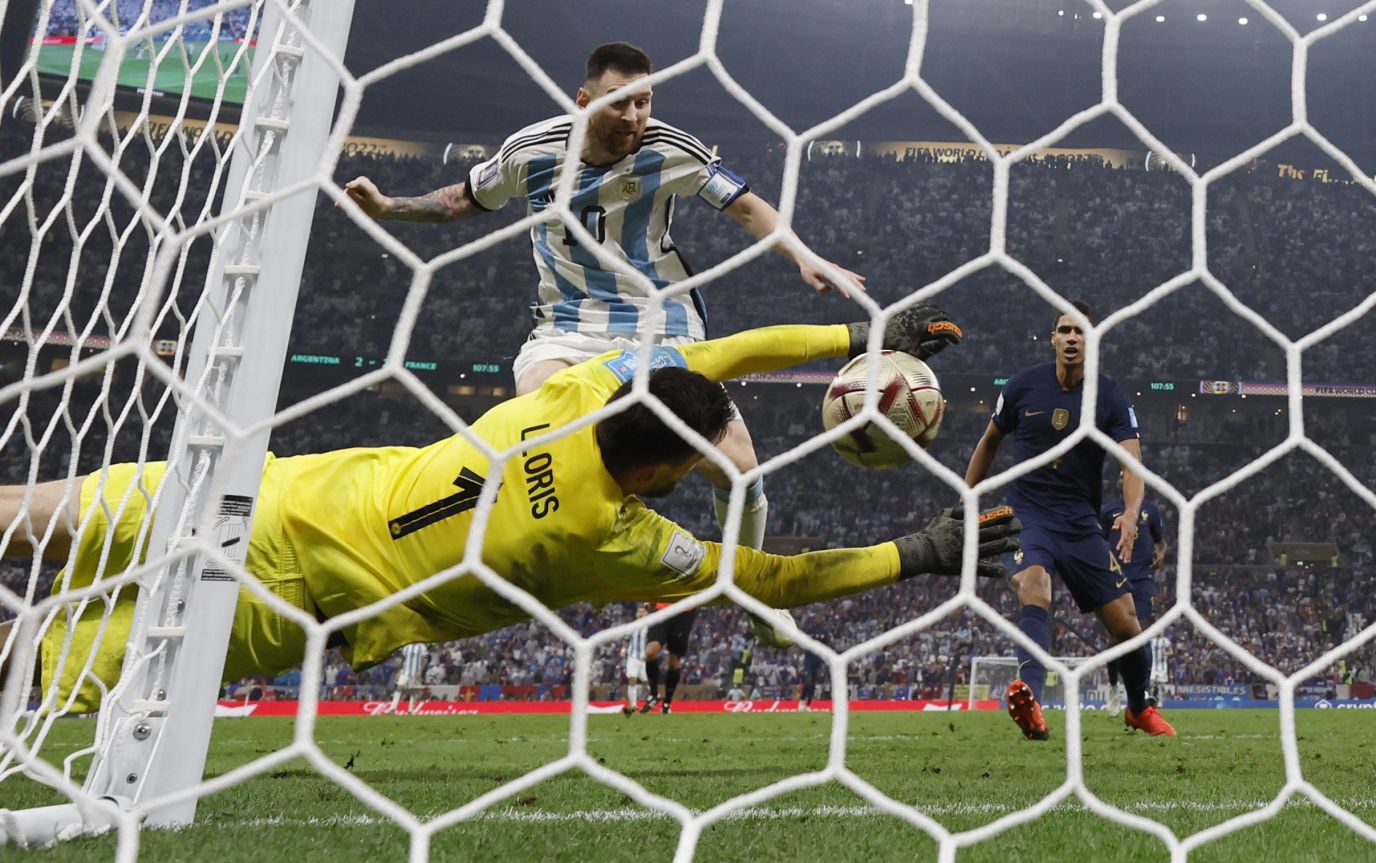
With the game now in overtime, Messi’s goal in the 109th minute appeared, finally, to be the winner. The play that led to the goal started with a ball passed seemingly innocent high ball into the air where it was masterfully back-heeled on a short-hop by Martinez to Messi, who passed it to Alvarez, who then finished off the triangle back to Martinez. Martinez’s shot was blocked by Lloris but Messi, like any good forward knows to follow the path of the ball, was right there to pounce on the rebound. A French defender cleared the ball but only after it was a full three yards past the goal line. The holographic offside replay showed that Martinez was onside only because the last French defender’s derriere enabled it.
It’s important here to take a detour into past history. This game’s ebb and flow was similar to that of the 1986 World Cup Championship game between Argentina and Germany. In that game Argentina raced off to a 2-0 lead before Germany struck back with two quick goals of their own to tie it. An undaunted Maradona led his team back by providing the assist for Burruchaga’s winning goal at the very end of the game. Like Maradona, Messi provided the key play here as well.
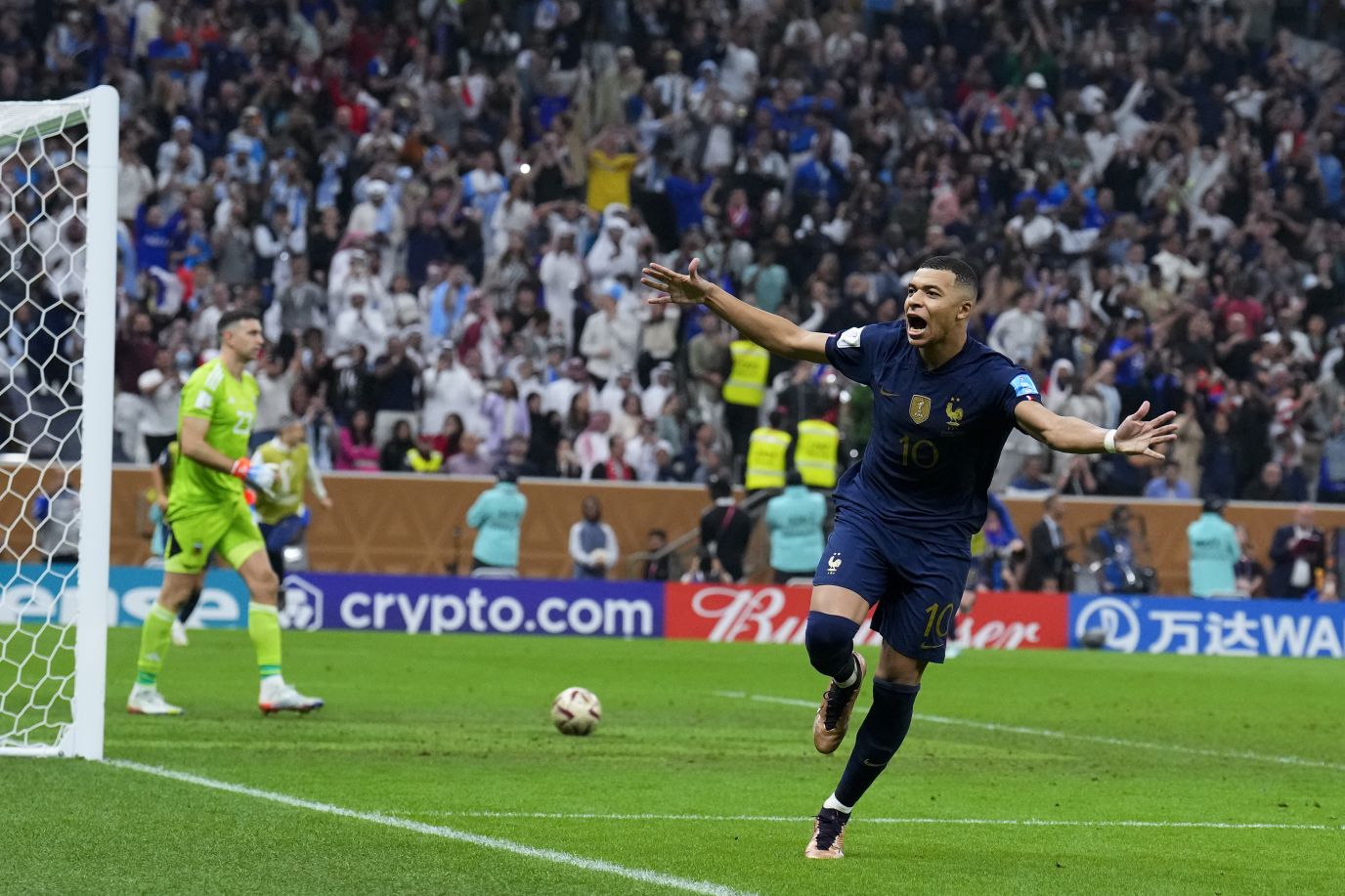
It is at this juncture, however, that this game eclipsed the 1986 thriller played in the Azteca both in terms of quality of play and the drama that is a direct consequence of it. A late penalty kick awarded to France from a handball by Gonzalo Montiel gave Mbappe a chance to score yet again. Montiel jumped up to block a shot from Mbappe and it hit his extended right arm in the elbow. Mbappe, who had already made one PK, stepped up and hit the second one hard to Ramirez’s right. The game was tied yet again; the French having come back a second time.
Mbappe ties the game again with his third goal of the match.
More drama and late heroics were to come. Deep into the second half of extra time. Emiliano Martinez came to the rescue, His acrobatic kick save off of Muani’s shot saved Argentina. It would have been a dramatic way for France to cap off their comeback. That would have been France’s knockout blow; it would have denied Messi his Cup.
What made this game exceptional was the fact that it changed course so dramatically. While one team completely dominated for 80 minutes, the last 40 were as scintillating a game as there has ever been played, especially given the stakes. The back and forth, the swings in momentums, the extra time, Messi vs Mbappe. The storylines discussed before the game all materialized during the game. This was not only a heavyweight match between two great teams, but it was also one between two great players: one Messi the GOAT, and one Mbappe, who if he keeps playing at this level, seems to be the only current player on path to eclipse Messi someday.
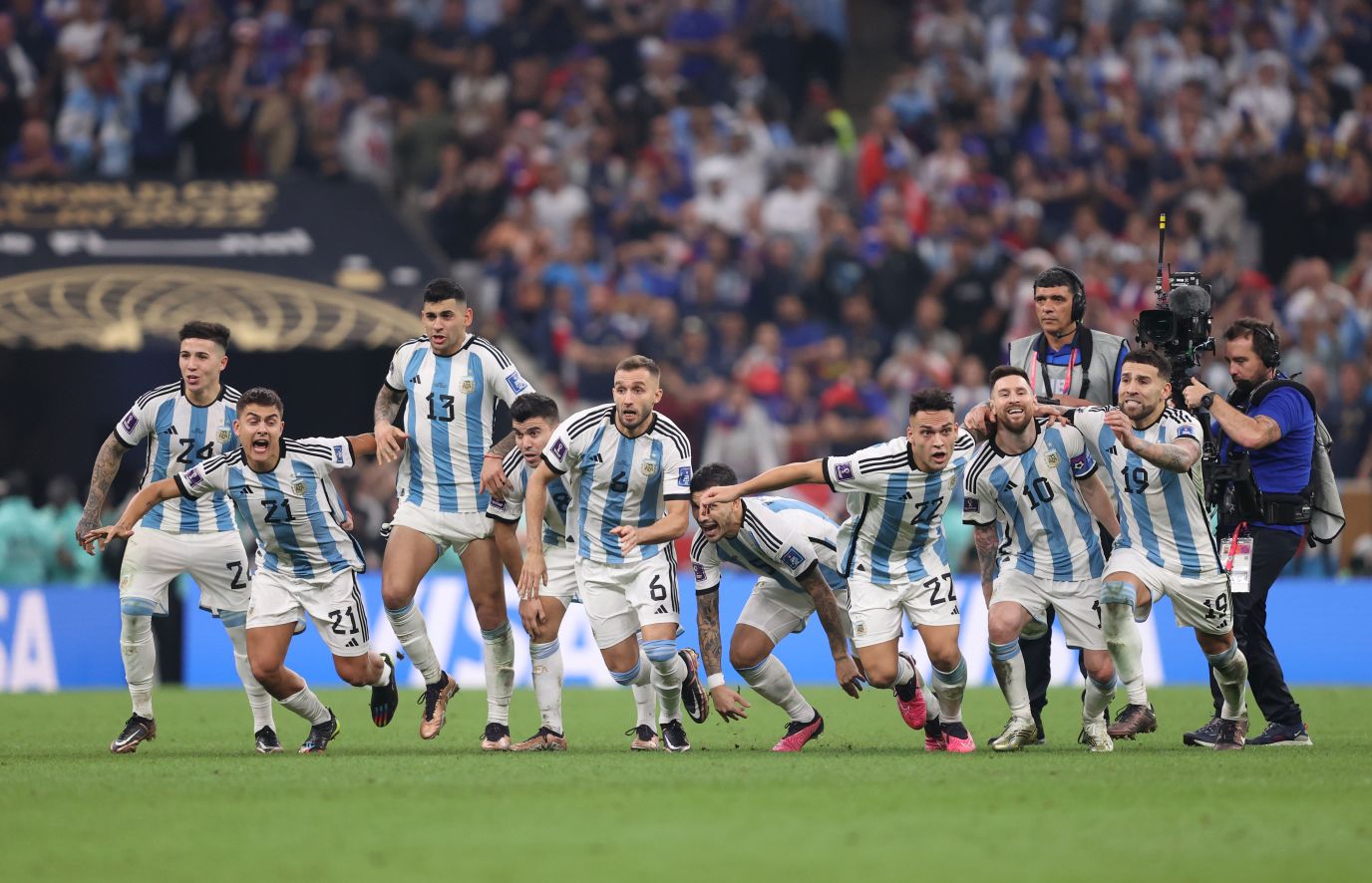
Argentina’s team runs towards Montiel after his final PK clinched the title.
At the end Argentina won a tense penalty kick shootout 4 to 2.Gonzalo Montiel, whose handball had allowed France’s Mbappe to tie the score at 3 in the dying moments of extra time, calmly slotted the ball past Hugo Lloris to finally win it.
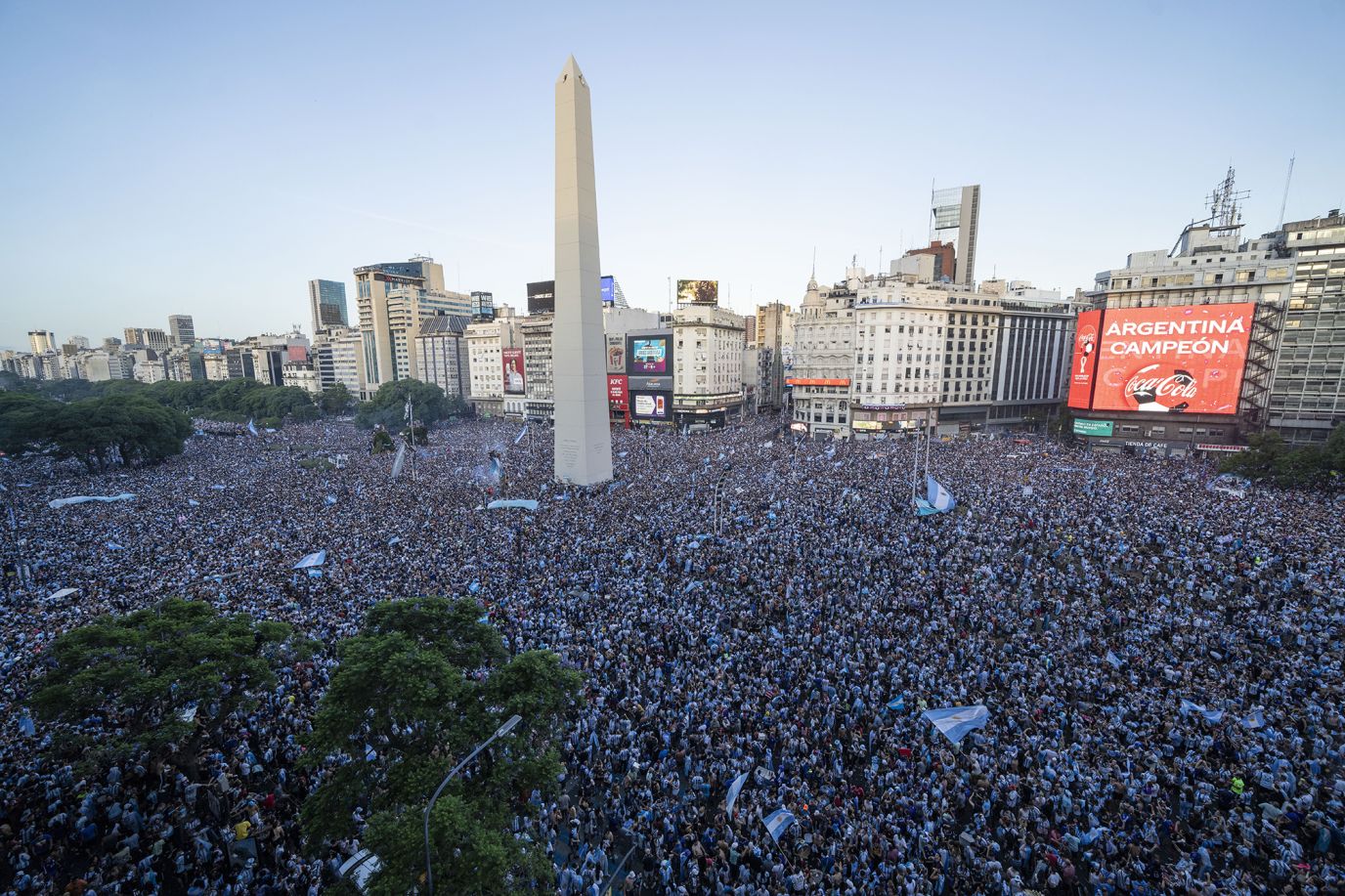
The team quickly embraced Montiel and celebrated their third win overall and their first cup in 36 years. Messi finally had his trophy, and in the process, had finally eclipsed his idol Diego Armando Maradona.
Notes:
The back and forth was not only for team but also for individual glory. Messi started out one goal ahead of Mbappe in the Golden Boot, then went ahead by two goals before Mbappe scored three to eclipse his Paris St. Germain teammate. A consolation prize no doubt but still a great individual triumph for a player that showed great character by never surrendering, by willing his team to not one, but two, improbable comebacks.
Messi set a number of records in this game: a) most games 26 surpassing Lothar Matthaus , b) most minutes 2,300(surpassing Paolo Maldini), c) Argentina’s leading scorer at the WC, beating Gabriel ‘Batigol’ by three goals.



 futbolstuff