World Cup Final: Spain 1 – Argentina 0

MetLife Stadium, East Rutherford New Jersey

Full Match Highlights (FIFA/YouTube) | Full Match Stats — Opta Analyst | ESPN Match Report

In this much anticipated final, it was never in doubt that Spain’s ability to hold on to the ball coupled with their suffocating defense would be an extraordinary factor (the best defense is a good offense concept so the two are not mutually exclusive) and that this would make them as slight favorites to win the game. 

Counter to that was that Argentina was a team of destiny, a team fueled by emotion and togetherness (many of the starters won it all in 2022), a team that would enjoy overwhelming fan support (the home field advantage theory), and that by virtue of having the best player on the planet, let alone on the pitch, would be sufficient to eek out a victory despite being dominated by their opponents.

The former narrative prevailed and it wasn’t even close. This game was not a game for the ages if you judge games by their competitiveness and the drama they produce. It was a game for the ages for the victors for their utter and complete domination, for their ability to reduce the world’s greatest player to a mere participant, and to put a drubbing so complete that the opposing team just couldn’t help but lose its mind after it was all over.

By completely erasing Messi from the equation early on (he had 3 touches in the first 15 minutes with the kickoff counting as the first), Spain delivered the equivalent of a knock-down (not out) blow in the first minute of a boxing match. Argentina would get off the mat, but barely survive the rest of the game, holding on to dear life using every dirty little trick in the book in the hope of holding Spain for as long as it took to get to the vaunted penalty kick shootout, which, fortunately, never came. Although it must be said that had Argentina’s Enzo Fernandez not drawn the stupidest of yellow cards for dissent in the first half, and thus earning a red-card for an obvious second yellow foul on Kubarsi in extra time, Argentina may have been able to hold on.  And there’s absolutely nothing that would have guaranteed Spain winning the shootout. Had Argentina been able to hold out 15 more minutes and won the PK shootout, it would have been the greatest travesty in the history of World Cup finals, or maybe even of all time.

After Ferran Torres scored in the 106th minute, after Spain had been knocking on the door the entire game, and after, it must be said, they had had a goal annulled due to a stepping on the boot foul from Mikel Merino on Otamendi in the box in yet another example of FIFA’s refereeing favoritism towards Argentina on debated plays that permeated the entire tournament, Spain looked like it had already won the game. But at this point, a desperate Argentina, started to actually play football, finally producing its only 2 shots of the game, and for a minute, it looked like they would tie the game.  These last minutes were, suffice it to say, quite tense.

In the end Spain did prevail. The statistics tell a tale of inexplicable dominance, of superiority on every level of the game: defense, passing, possession, chances created, composure, etc. Two statistics stand out: field tilt of 83.3 % and number of passes completed (763 for Spain, 357 for Argentina). Had it not been for Martinez’s historic night, this could easily have been a 3 or 4 to nil rout.

At the end, as Spain’s players poured out to celebrate, things got ugly. Argentinian players raced around trying to find anybody to punch, kick, and even choke. One particular player, Leandro Paredes, grabbed Eric Garcia by the throat and threw Gabi to the ground. (This is the same player who started a fight in Qatar 4 years ago against the Netherlands when he fouled a Dutch player and after doing so kicked the ball forcefully at the Dutch bench, causing a bench learning brawl baseball players can identify with, and in the process, causing world-wide opinion that Argentina, while a very talented side, also possessed a darker side to them.) Other scuffles broke out and Argentinian coach Scaloni finally was able to restrain his payers and stop the madness. During the fracas, Messi sat all by himself on the other side of the pitch, not willing to participate in the atrocious display of bad sportsmanship exhibited by many of his teammates. Paredes earned a red card for his action after the game although FIFA, for some odd reason, retracted it as an administrative error.

The trophy presentation was even more bizarre, with the President of the United States trying to join the Spaniards in their celebration, only to be escorted out by his new best friend, FIFAs president Infantino. And as a final insult, as Spain celebrated, Argentina turned their back, unable or unwilling to applaud the champions.

In the end analysis, none of the noise mattered. Spain collected their second star in what will be remembered as a defense for the ages.


Full Match Highlights (FIFA/YouTube) | Full Match Stats — Opta Analyst | ESPN Match Report


From the opening whistle at MetLife Stadium in East Rutherford, New Jersey, it was clear this was going to be a different kind of final. Not the open, end-to-end thriller the neutral had hoped for. Something more clinical. More suffocating. More Spanish.

Spain possessed. Argentina could not. From the very first exchanges, Rodri and Fabián Ruiz imposed themselves in midfield, controlling the tempo and denying Argentina any opportunity to build rhythm through their usual channels. Scaloni’s side were forced to go direct — long balls over the top, hoping that Julián Álvarez or Lautaro Martínez could hold something up, could bring Messi into the game. It did not work. Within ten minutes the pattern was already set and already alarming.

By the 20-minute mark, the most unsettling statistic of the game had already declared itself. Messi had touched the ball just three times. Three touches. For the greatest player in the history of the sport, in a World Cup final. The extended feeling-out period that both teams went through in the opening quarter served Spain perfectly and Argentina disastrously — because Messi cannot beat you if he doesn’t have the ball, and Spain had the ball almost all of the time. The “Olés” were already beginning to ring around the stadium from the Spain supporters as possession ticked up and up in their favour.

At 40 minutes, another landmark — and not a welcome one. Argentina had still not registered a single shot on goal, making them the first team on record to fail to attempt a shot in 90 minutes of a World Cup final since records began in 1966. Spain, meanwhile, had produced two shots on goal and were knocking with increasing confidence. An early opening had seen Yamal’s effort take a deflection before Martínez adjusted well to make the save — the first of what would become a historic catalogue of stops.

The first half ended goalless, but the scoreline was flattering to Argentina. What had transpired was a defence versus attack exercise as the holders showed spirit but precious little else. The question at the break was not whether Spain would score, but when — and whether Martínez could hold out long enough for Argentina to somehow manufacture a chance from nothing.

The second half began with Spain continuing to knock. Yamal created an excellent opportunity for Torres after 67 minutes but he headed too close to Martínez, who gathered comfortably. Pau Cubarsi and substitutes Pedri and Williams all drew saves from the Argentine custodian as the pressure continued. By the hour mark, Martínez had made five saves. Spain were loading the cannon shot by shot, corner by corner, and each time the Argentine goalkeeper threw himself in the way. It was a one-man resistance. It could not go on forever — but it went on longer than anyone had any right to expect.

Spain thought they had taken the lead when Williams fired into the net, but the goal was ruled out for a foul on Otamendi by Merino in the build-up. The crowd groaned. The Argentine bench exhaled. VAR, for once, working against the tournament’s narrative rather than with it.

Then came the two-minute sequence in stoppage time at the end of regulation that changed everything.

First: Enzo Fernández. Already on a yellow card received earlier for dissent, his late challenge sent Pau Cubarsi twisting and flying into the air before crashing to the turf — a brainless, inexcusable foul at the worst possible moment. Second yellow. Red card. Fernández became the sixth player to be sent off in a World Cup final, with 50% of those ejections belonging to Argentine players — Monzón and Dezotti in 1990, and now Enzo in 2026.

Then: Yamal. Standing over a free kick 25 yards from goal, in the last seconds of normal time. The stadium fell quiet. He struck it with ferocious precision — a vicious, dipping delivery destined for the top corner. Martínez, who had spent 94 minutes walling off Spain’s best efforts, launched himself to his right and turned it over the bar with a flying save that drew a gasp from every corner of the stadium. By that point he had broken the championship-game record of eight saves. He would finish with 11 — the most by any goalkeeper on record in a FIFA World Cup final.

Extra time. Ten men versus eleven. Argentina, paradoxically, finally began to attack — because they had no other choice. Spain had the harder time holding the ball now as Argentina threw bodies forward in desperation for the first time all evening. Two shots — their first of the entire game, arriving after 116 minutes of play. And then the clearest chance Argentina would get all night.

Giuliano Simeone, unmarked in the centre of the penalty area, received the ball in space — the kind of position he had repeatedly threatened from throughout the tournament. This was the moment. He shot. It went well above the crossbar — not close, not unlucky, but the kind of miss that happens when a team has spent 116 minutes without a shot and suddenly finds itself asked to deliver in the most important moment of its life. The chance was gone. Argentina would not get another.

Then, 37 seconds into the second period of extra time — at 106′ — it was over.

Pedro Porro crossed from the right. Nico Williams, arriving at the far post, nodded it down with perfect weight. Ferran Torres, on as a substitute, met it with a first-time shot rocketed into the roof of the net. Martínez had no chance. “Honestly I did not think too much,” Torres said on the Fox broadcast afterward. “I just saw the ball coming to me and I shot with the power of all the Spanish people.”

Torres became just the second substitute to score the winning goal in a World Cup final, after Mario Götze in 2014 — also against Argentina. History has a sense of humour.

Five minutes of injury time were added at 120′. Argentina’s first shot on goal — their first in the entire match — had come from Messi in the 117th minute. Spain held. The final whistle blew. Ugly scenes followed as Argentina players lashed out at Spanish players celebrating, the raw grief of a defeated team finding no elegant exit. Spain finished with an xG of 1.94 from 20 shots. Argentina’s tally: 0.2 from two attempts.

Spain allowed just one goal in the entire tournament — their seventh clean sheet — and finished undefeated, having begun the whole campaign with a 0-0 draw against Cape Verde in the opening game. De la Fuente, the oldest manager to win the World Cup, completed a remarkable journey from that opening stumble to the summit of world football. He is now 14-0-1 as Spain’s manager. The bus that left Cape Verde without a result arrived in New Jersey with the trophy.

PKs:

Unai Simon 7 clean sheets. Most of any tournament. Golden glove.

Kubarsi best young player. Great analysis of his brilliant mind:

Rodri best player of tournament. Approaching best defensive midfielder of all time status.

Messi crying after receiving his medal was very telling of how much he wanted to win, how much he cared. Although I rooted for Spain, I think Messi was also deserving of a title, but unfortunately, his team, in the end, was not good enough today.

Great retrospective on the final. The good (Spain’s excellence) and the bad (Argentina’s performance on and off the field, the halftime show, 47’s pathetic lingering on the winner’s stage)

Argentinian players unveiled a sheet with the words: “The Malvinas have been, are, and will always be Argentinian.” after the game against England. Another example of how fervent nationalism and the politics it evokes is a stronger force than the game itself.

The game was preceded by a rousing rendition of Star Spangled Banner followed by stupid ass rendition of FIFA anthem “Desire”. The contrast of excellence to corniness couldn’t be starker.

7/15/26: Argentina 2 — England 1 Atlanta Stadium, Atlanta · World Cup Semi-Final

Full Match Highlights (FIFA) | The Athletic Podcast — Tuchel’s Strategy Breakdown

There are football rivalries, and then there is Argentina versus England. The word “rivalry” isn’t sufficient to describe what it feels for these two countries to play against each other, on the pitch, in the stands, or in the respective nations. This is something older and darker and more personal than sport — a wound that history keeps reopening, dressed in blue and white on one side and red and white on the other. Wars have been fought between these two nations. Entire careers have been defined and destroyed by their meetings on a football pitch. Goals scored in these games have transcended sport and become cultural mythology. To call it the bitterest rivalry in football is not hyperbole. It is simply the truth.

And yet they hadn’t played each other in 21 years. Not since a friendly in 2005. Not in a World Cup knockout match since 1998. All of that accumulated history, compressed and held, waiting to detonate — and on Wednesday evening in Atlanta, it finally did.

The History That Made This Match

Before a ball was kicked in Atlanta, it was worth pausing to understand the weight of what was about to happen.

The 1986 World Cup semi-final at the Azteca produced two of the most famous goals in the tournament’s history, both authored by the same man, five minutes apart. First came the Hand of God — Maradona punching the ball into the net with his left fist, deceiving referee Ali Bin Nasser, then telling the world he had done it “a little with the head of Maradona and a little with the hand of God.” Four minutes later came the Foot of God — a solo run from the halfway line that beat five England players and Peter Shilton, a goal that FIFA’s fans would later vote the Goal of the Century. Argentina won 2-1 and went on to lift the trophy. That single game was the spark that ignited a fire between two nations that has been burning ever since. Maradona reached deity level status with that performance — D10S, a merging of “Dios” (God) and his shirt number, a word that fans printed on the back of his replica shirt and meant it with every sincerity. He could do no wrong in the eyes of his country for the rest of his career.

Watch the 1986 goals

The 1998 World Cup in France added another chapter. Michael Owen, 18 years old and electric, announced himself to the world with a goal of breathtaking pace and composure. England led 2-1 before Argentina equalized in controversial circumstances and the game ended 2-2. Then came the defining moment: David Beckham, provoked by Diego Simeone — yes, that Simeone — kicked out and was sent off. Ten men. Penalties. David Batty and Paul Ince both missed. Argentina went through 4-3 on penalties. England went home. Another penalty kick shootout disappointment in their ledger.  Beckham went home to death threats and an effigy burned in the streets. Watch the 1998 classic.

Four years later in Japan, at the 2002 World Cup, England finally had their revenge. In the Sapporo Dome, a deeply personal stage for Beckham, now captain, who had spent four years carrying the weight of that red card, England won 1-0 through a Beckham penalty just before half-time. Mauricio Pochettino — now a celebrated club manager — conceded the spot kick. Argentina, despite pressing furiously in the second half, could not find a way through David Seaman, who made a crucial point-blank save from Pochettino’s header at 77′. It was England’s first competitive victory over Argentina since 1966. Beckham converted the penalty with ice in his veins and celebrated with tears in his eyes. “It feels better than it did four years ago,” he told the BBC afterward. “It’s been a long four years.”

Now, in Atlanta, in 2026, these two nations met again in a World Cup semi-final. Both the most battle-tested teams of the final four. Argentina had won six games, five of them coming from behind, surviving the VAR controversy against Egypt and the sheer force of Egypt’s resistance that required three goals in thirteen minutes. England had beaten the United States, Belgium, Mexico with ten men against the altitude and atmosphere of the Azteca, and Norway in the quarter-finals, relying heavily on Harry Kane’s goals and the increasingly exceptional Jordan Pickford between the posts. Neither team had arrived here easily. Neither team was going to give this up without a war.

The First Half — Frenzy, Fury, and Precious Little Football

It started before a ball was kicked. The Argentine players sang their national anthem with the full-throated ferocity of men going into actual battle. Forty thousand blue-and-white shirts in the stands responded. The noise inside Atlanta Stadium was extraordinary — not the polite appreciation of neutrals watching a spectacle, but the raw, visceral roar of partisans with everything at stake. You could hear the chants of Argentina, Argentina from outside the stadium.

And then the game matched the atmosphere, blow for blow, elbow for elbow.

Within two minutes, Jude Bellingham was caught in the face by Leandro Paredes’ elbow. In the seventh minute, Giuliano Simeone — about whom more shortly — fouled Elliot Anderson to give England a free kick. At the 13-minute mark, Anderson and Fernández were at it again, and they looked ready to come to blows, with Morgan Rogers and Paredes joining in. Tuchel remonstrated furiously on the touchline. No cards. By the time the first hydration break arrived, the two squads had combined for eight fouls and zero official shots on goal — a statistic that tells you everything about the tone of the opening minutes..

At half-time the scoreboard read: nineteen fouls, two yellow cards, zero shots on target — almost certainly the first World Cup semi-final since records began with no first-half shots on goal, and the first game since 1966 without a shot on target in an entire half. The only genuine sight of goal came at 38′, when Enzo Fernández shaped a free kick that tested Emiliano Martínez. Elliot Anderson received his yellow card at 38′ for a robust challenge on Messi. Lisandro Martínez was booked at 42′ for cynically hauling back Rogers.

Into the middle of all this combustion stepped a name that rang with historical resonance: Giuliano Simeone. Diego’s son. Playing only his 71st minute of football in the entire tournament, Scaloni inserted him — apparently not for his technical gifts, though they are considerable, but for precisely what he demonstrated in those opening exchanges: the chip-off-the-old-block fighting spirit that seems to flow in the Simeone bloodline. Diego Sr., of course, was the man who wound up Beckham in 1998 and was central to England’s most painful World Cup night. Junior picked up the baton with relish, involved in numerous flashpoints, driving Argentina forward physically and psychologically. Both Simeones — Diego as a player and coach, Giuliano now — represent the ethos of the Argentine pibe in its purest form: real skill married to fighting spirit, gamesmanship, trickery, and a total refusal to be intimidated. Maradona embodied the same quality. This quality, transmitted across generations, is part of what makes Argentina Argentina.

The Second Half — Dickens in Reverse

Dickens, albeit inverted, comes to mind here. It was the worst of halves and the best of halves. If the first half was all about physicality, intimidation, and standing your ground (give no quarter take no quarter), the second half, by contrast, was all about magnificent football. England daring to take the lead and then daring Argentina to take it back.

Argentina came out for the second half with an immediate change of gear. Julián Álvarez, getting the better of Djed Spence, fired twice at Pickford in rapid succession early in the second period — the first blocked at the near post, the second deflected into the side netting. Then, at 49′, Jude Bellingham appeared to obstruct Messi in the box — bodies colliding, no call, replays suggesting England got away with one.

And then, at 55′, England scored — and the entire complexion of the game changed.

Lisandro Martínez acrobatically cleared but only as far as Declan Rice, who picked out Morgan Rogers to swing in a delightful cross that was swept home by Gordon — arriving at the back post and guiding the ball past Emiliano Martínez with his first career World Cup goal. 1-0 England. And then Thomas Tuchel made a decision that will be debated for years.

Tuchel’s Double-Decker Bus — and Why It Failed

The Athletic Podcast discusses this in detail

England parked the bus. Not just any bus — a double-decker (note references to this exact wording in the podcast above).. The entire team dropped deep, surrendered possession, and invited Argentina to come at them. What worked against Mexico — barely, with ten men, on the day Bellingham scored twice in two minutes — was now deployed against a different animal entirely. You do not give a footballing genius 35 minutes to decode your defensive strategy. You do not invite Messi to probe and probe and probe until he finds the answer. This was not caution. This was abdication. At 72′, Tuchel substituted Anthony Gordon — the goalscorer — for Ezri Konsa, a centre-back, adding defensive cover and draining what little attacking threat England had retained. The message was clear: hold what we have. Contain them. Dare them to score.

Argentina responded by throwing everything forward.

At 58′, Giuliano Simeone broke clear with a chance to equalize, arriving on goal alone — before Djed Spence delivered one of the tackles of the tournament, a perfectly timed slide that dispossessed him without a hint of foul. A goal-saving intervention that deserved far more credit than it received in the noise of the following minutes.

At 68′, Pickford produced a save of the highest order. Messi whipped a cross into the area and Nico González got his head to it from the centre of the box — point-blank, certain goal. Pickford got down sharply and palmed it away with one hand. Breathtaking.

At 76′, the post intervened on England’s behalf. Alexis Mac Allister met Rodrigo De Paul’s peach of a cross — a genuine gem of a delivery — and threw himself at it, thumping a header that crashed off the inside of the left post with Pickford rooted to the spot. At that moment Argentina deserved to be level. They were not. The post held. The scoreline held.

At 84′, Pickford produced another reflex save — this time from distance — tipping a Fernández drive over the crossbar. (These two saves matched in the two against Mexico and it appeared, for a minute, that England would hold, that their hot goalkeeper in full flow, a man channeling every save into the belief that this was England’s night, was was about to wipe that sixty years of pain away.

They weren’t.

Messi — Left Foot, Right Foot, Both Feet on History

The equalizer came at 85′. Fernández, who had seen that shot tipped over, did not panic. He set himself twenty yards out at the top of the 18 yard box. Argentina took the corner short to Messi, who swung around to his left, and sent a perfect pass to Enzo, who bent a superb finish around the crowd and into the far side of the net. Pickford, who had been brilliant up to that point, was just positioned fractionally wrong. Argentina had their tenth goal after the 75th minute in this World Cup. The stands erupted. England’s resistance, built on Pickford’s heroics and the posts’ charity, had cracked.

And then, at 90+2′, Messi crossed with his right foot. Lautaro Martínez, who had scored the Copa América winner in 2024, met it at the far post and headed it home. England’s World Cup dreams were buried. Messi had assisted both goals — the first with his left foot to Fernández, the second with his right to Lautaro.

The brilliance of that moment cannot be understated. Having utilized his left foot the majority of the match (and tournament), Messi did the equivalent of a basketball cross-over. After collecting a loose ball, he dribbled to his left as customary before a wicked change of direction to his right beat two England defenders before putting in his cross.

The goal, it must be stated, did not come without significant controversy. Should Messi have been ruled to have committed an accidental foul when he stepped on Spence’s foot trying to collect the loose ball, thus giving him an advantage at the key point where he dribbled to his right ? Should the resulting goal had been disallowed after a review of the play, akin to how Egypt’s goal was after a similar stepping of the foot foul from an Egyptian defender ? This point will be hotly debated for years to come. Was this Messi’s equivalent pibe move like Maradona in 1986; using a little chicanery to gain an advantage ?

I am of the opinion that this was and it wasn’t.

It was accidental and he got away with it as the referee didn’t call it and it wasn’t reviewed by VAR (just like Maradona). Why it wasn’t reviewed by VAR is another point entirely and the subject of another debate altogether, not withstanding FIFA’s official VAR reviews that determined the contact did not meet the threshold for a “clear and obvious error”.

See https://encrypted-vtbn1.gstatic.com/video?q=tbn:ANd9GcSw_apeXxSGXtItkrrblyVmQ_vzpok0_JwayeZ_HVJEUrYCujl6

But it wasn’t in the sense that Messi didn’t plan to do this, it just happened. (Maradona did for sure put his hand up there on purpose and just didn’t think he would really get away with it.)

A Team of Destiny

Argentina have now scored nine goals in the final fifteen minutes of games at this World Cup. They have come from behind in game after game — against Cape Verde, against Egypt, now against England. They are indefatigable. They are relentless. They are the comeback kings.

Coach Lionel Scaloni said it perfectly after the final whistle: “I think that this team plays the best when we are facing a difficult situation, with adversity. We had a challenging game, a challenging situation. There was blood in the water, and we went for it.”

The reason for all of this is clear. It has been clear since the tournament began. Argentina are a team of destiny because they are led by their second D10S. Not the hand of God this time. Not the foot of God. Just the left foot and the right foot of the greatest player who has ever lived, still performing miracles at 39, still dragging his country toward immortality, still reducing the entirety of English football to heartbreak in the final minutes of a World Cup semi-final.

Diego would have smiled.

PKs:

Argentina’s xG was 1.84 from 15 attempts. England’s was 0.53 from five. The numbers, as they always do in this tournament, told the truth about who the better team was.

Here’s a shocking statistic. After scoring their goal at the 55th minute, England completed a grand total of 27 passes for the rest of the game. That’s less than one pass per minute ! I replayed the entire second half on Telemundo and closely observed to see if this was true, because as many others looking on, would not believe that this was true. The even more shocking thing is that 7 of those passes were in the immediate aftermatch of the goal, leaving 20 for almost 35 minutes of remaining time. Looking ahead to the final, Spain can make that many passes in a single minute, further proof that no matter the score, Spain will NOT, repeat NOT concede the ball to Argentina and the miniature magician.

At 80’ mark, the substitution patterns continued to mirror and reinforce the respective tactical patterns of the second half. Argentina put in Lautaro Martinez (offensive) and England put in two gigantic defenders (Dan Burn and Nicolas O’Reilly) to finish off the double decker part of their ‘bus’. It’s ironic, isn’t it, that Argentina ended up scoring on a header by Lautaro !

In the 85th minute, Messi had probed the approach with his right foot with Spence defending. While it didn’t work that time, it gave Messi the data point he needed for the cross that did work later on. The experiment proved that Messi could beat England defenders that way. It also probably was a kind of “pump” fake, to borrow another basketball analogy, that he wouldn’t try that again.

Argentina face Spain in the final on Sunday in New Jersey. Messi vs Lamine Yamal. The man who held the baby, against the baby. The living legend, against the game’s next great prince. It is, as it has been all tournament, almost too good to be true.

Great article on Messi’s dribbling prowess:
https://www.nytimes.com/athletic/1880554/2020/08/07/lionel-messi-barcelona-la-liga-champions-league/

Spain 2 – France 0

Dallas Stadium, Arlington, Texas · World Cup Semi-Final

Full Match Highlights

Bastille Day. France’s national holiday. The day the French stormed the fortress. Except on this Bastille Day, in Dallas, Texas, it was Spain who did the storming — and France who discovered that some fortresses cannot be taken, no matter how many superstars you throw at the walls.

The stage was set for a classic semi-final. One of the Cup’s best offenses (Argentina was the other) against the best defense. The two most complete squads in the competition, the two most feared attacking units, the climactic clash of European giants on a World Cup semi-final stage.

The inevitable saying springs up: something had to give.

What it became instead was a masterclass in defensive suffocation — and a painful, comprehensive lesson in what happens when the game’s most vaunted attacking trident runs headlong into the best defensive unit of the tournament. (Here it is comprehensive to state another sports truism: “Offense entertains but Defense wins championships.”)

France looked impotent. There is no softer word for it.

Cucurella’s Night — and Olise’s Nightmare

Let us start with the man of the match, and it was not the man most people expected to be talking about the morning after. Marc Cucurella — the curly-haired left-back who once had his hair famously grabbed by Jack Grealish in an incident that went viral at Euro 2024 — was absolutely magnificent. Tasked with policing Michael Olise down France’s right flank, he was a wall, a menace, and, at one delicious moment, something of a showman.

Cucurella picked up a yellow card after hacking Olise down twice in quick succession in the first half — physical, aggressive, refusing to give the PSG star, who up to this point in the tournament had been exception, a centimetre of comfort. But it was what he did with the other half of his game that elevated this performance. He won five duels across the ninety minutes, and crucially intervened in injury time to deny Mbappé the chance to break through in the box when France were throwing everything forward in desperation.

At one point in the first half, having won yet another duel and left Olise on the turf, Cucurella turned back, said something, and — in what felt like the defining image of the evening — casually ran a hand through his gloriously abundant hair. Whether it was deliberate theatre or just instinct, it was funny, it was cocky, and it was entirely earned. Olise, for his part, did not attempt a single dribble in the game and his only two shots came in the 96th and 97th minutes — dead rubber moments in stoppage time when the game was long since over.

Cucurella owned him. Completely.

Cubarsi, Laporte, and the Mbappe Erasure

On the other side of Spain’s back line, 17-year-old Pau Cubarsi and veteran Aymeric Laporte formed a partnership that gave Kylian Mbappé precisely nothing to work with. Cubarsi did the front-foot defending while Laporte handled the passing and sweeping up behind — a division of labour that looked almost telepathically coordinated. Between them, they turned the French captain into a peripheral figure for the majority of the ninety minutes. A thoroughly professional performance, if ever there was one, a result of brilliant game plan, that completely neutralized one of the world’s most magnificent players.

In a game of few standout moments for the France captain, Mbappé managed just one genuine moment of threat — beating Pedro Porro to the near post at 64′ and firing from a difficult angle, forcing Unai Simón into his first save of the game. That was it. The most expensive player in the history of the sport, reduced to one low-percentage snapshot from a tight angle. In the dying minutes, with France chasing the game in desperation, Mbappé shot it over the bar at 89′ before earning a yellow card at 86′ for shoving Simón while trying to press — seemingly out of pure frustration.

Ousmane Dembélé was similarly anonymous against Cucurella. He, too, had no answer. It was just that kind of day for Dembélé, Mbappé, and Olise.

Rodri — The Engine of Everything

If Cucurella was the defensive hero, Rodri was the heartbeat. The Ballon d’Or winner completely shut down any and all traffic through midfield and made every part of life easier for his teammates — reading danger before it developed, recycling possession with his customary calm, and providing Fabián Ruiz the platform to join in Spain’s attacking sequences. Aurélien Tchouameni, returning from a thigh strain, had no answer: despite recording 88% pass accuracy, Tchouameni completed only three passes into the final third — a damning statistic that tells you everything about how completely Rodri and Ruiz owned the middle of the pitch.

The best midfielder in the world was, once again, the best midfielder on the pitch.

Lamine’s Gift — Oyarzabal’s Penalty (22′)

The deadlock was broken not by Yamal’s feet but by his intelligence. A day after his 19th birthday, he got to the ball before Lucas Digne and was clipped inside the box — a clever, brave run from a teenager with not a nerve in his body. Mikel Oyarzabal stepped up to the spot in the 22nd minute. With a medium-pace run-up and no stutter other than a hop at the start, he struck a clinical penalty into the upper reaches of the goal. Maignan read it correctly but it didn’t matter when the kick was that good. 1-0 Spain. And somehow, already, you felt it might be enough.

France had a dangerous free kick at 88′ that could easily have been awarded as a penalty. Yamal fouled Doué right at the corner of the box — it was so close to being a penalty; Yamal got away with one there. Had that gone to VAR and been given, the entire complexion of the final stages would have been different. It wasn’t. It’s the fine margins that define these things.

Porro Makes it Safe — The Second Goal (58′)

The game was settled in the 58th minute in a passage of play that perfectly encapsulated everything Spain have been about at this tournament — quick, incisive, and utterly clinical when the moment arrived. Porro broke through from right-back and split the French defence with a one-two with Dani Olmo in the middle, adding a deft finish beyond an onrushing Maignan. It was a right-back playing like a winger, timed perfectly to exploit France’s momentary disorganization. Neither Lacroix nor Digne tracked Porro’s run — an unforgivable lapse at a World Cup semi-final. He used the front of his right boot to side-foot it around the keeper. Composure personified.

Spain could even have had a third. Yamal curled in from close range but was denied by the offside flag — a marginal call that, on another day, might have been the goal of the tournament.

The Numbers Tell the Full Story

The statistics from this game are almost hard to believe, given the French squad that walked out onto that pitch. Spain’s defence restricted France to just 0.3 xG from 10 shots, with only three of those on target. Spain, meanwhile, accumulated 1.63 xG from 10 shots and scored with both of their attempts on goal. That is the definition of efficiency — and the definition of defensive genius. Spain, which had conceded one goal in seven matches at this World Cup, is unbeaten in 37 straight since losing a friendly to Colombia in March 2024.

Full Match Stats

France’s World Cup Ends Here

France — the 2018 champion and 2022 runner-up — was the most impressive team throughout the five-week competition by rushing through six matches by a 16-2 margin. But on Bastille Day, Les Bleus discovered nothing but frustration in trying to solve Spain’s airtight system.

Didier Deschamps will take charge of one final game — the third-place play-off on Saturday — before his long reign as French manager comes to its conclusion. It ends not with a trophy but with a shutout, a masterclass from the opposition, and the quiet, haunting recognition that France’s three-headed Hydra of Mbappé, Dembélé, and Olise — so devastating against every other opponent at this tournament — was simply, clinically, neutralised.

There was only one team that could have done this, beat France by completely neutralizing their high octane attack. Spain had done it before and believed it could do it again. They had deployed their own irrepressible attack in a 5-4 victory last year in the Nations League Final, staking a 4-1 lead before securing the victory with the final scoreline. They had also bested the Bleus 2-1 at the Euros in 2024. Dating back to their last 5 encounters, Spain held a 4-1 edge.

PKs:

In this World Cup, France looked invincible, winning, not by the bare minimums that Spain had, but by larger margins, with flair and style. Their attacking trio of Mbappe, Dembele, and Olise scored in bunches. They ripped through their group outscoring their opponents 10-2. In the knockout they punched Sweden in the face 3-0 before beating Paraguay 1-0 in a slugfest. Paraguay came to hit not play, knowing that there was no way they could compete against France trying to play an open style (they had tried that against the US in their opening game and got thumped 4-1 by the Americans). They then outclassed a very good Morocco team 2-0, the same way they had done 4 years ago in Qatar.

At this tournament, Spain had tied the Cup’s Cinderella Cape Verde 0-0 in the opening match before beating Saudi Arabia 4-0 and then surviving against Uruguay 1-0 in one of the tournament’s most offensive games to watch. Once the knock-outs started, however, the team found another gear, and won their next 3 games conceding only 1 goal. They outclassed Austria 3-0 before beating their inter-peninsular rivals Portugal 1-0 in the most technical game of the tournament (both teams field the best midfields in the world) before also outclassing Belgium 2-1.

7/7/26: Argentina 3 — Egypt 2

Full Match Highlights

There is a word for what Argentina are doing at this World Cup, and the word is destiny. There is no other rational explanation. Because rational explanations have long since packed their bags and left the building. What unfolded in Atlanta on Tuesday night was not football as a sport so much as football as theatre — and not the clean, cathartic kind. The kind with a morally ambiguous plot, a villain nobody can agree on, and a protagonist who makes you believe in miracles even when the evidence against them is overwhelming.

Argentina survive. Again. But this one will leave a mark.

The Opening — Egypt Draw First Blood

In the 15th minute, centre-back Yasser Ibrahim rose to meet Marwan Attia’s corner and delivered a glorious header that left Argentina stunned and trailing for the very first time at this World Cup. It was perfectly executed — the delivery arcing away from goalkeeper Emiliano Martínez, Ibrahim attacking it with conviction, and Lisandro Martínez caught in two minds between stepping out or tracking his man. He chose neither, and paid the price.

Argentina’s immediate response came at the penalty spot. Nicolás Tagliafico drew the foul, and Messi stepped up with a chance to immediately level the game. What followed was one of the most talked-about moments of the tournament. Goalkeeper Mostafa Shobeir read the direction of Messi’s left-footed strike perfectly, diving to his right to parry it away and preserve Egypt’s lead. The miss made Messi the first player in World Cup history to miss two penalties in a single edition of the tournament. Former Scotland striker Ally McCoist, watching on ITV, put it as plainly as anyone could: “He actually didn’t look really confident. I can’t believe I’m saying that of one of the greatest players on earth. It’s the first time I’ve ever seen him when I’m not sure he believed himself.”

Messi proved he is human. He placed the shot too close to Shobeir, who barely had to move his weight before launching himself at the ball. The GOAT, for once, looked mortal.

Shobeir’s heroics continued as he denied Alexis Mac Allister a chance to equalize from Rodrigo De Paul’s cross, and kept out Julián Álvarez from close range to send the teams to the break with Egypt still in front. For the first 45 minutes, the Pharaohs were not merely resisting — they were controlling. They were, simply put, the better team.

The VAR Storm

Then came the moment that will define this match in the history books — for better or worse, depending on which shirt you were wearing.

In the 58th minute, Mostafa Zico appeared to have scored one of the great World Cup goals, a brilliant finish at the end of a devastating Egypt counter that would have put the Pharaohs 2-0 up. Zico tore off his shirt in celebration. The Egyptian bench erupted. For a few extraordinary minutes, the world was witnessing one of the great upsets. Then VAR intervened.

A review determined that Egyptian midfielder Marwan Attia had fouled Argentina defender Lisandro Martínez in the build-up to the goal — the goal was ruled out. The problem, as virtually every neutral observer noted immediately, was the distance between the foul and the goal itself. FOX Sports analyst and former FIFA referee Mark Clattenburg was unambiguous: “I don’t believe that A. it was a foul, and B. there should be a VAR intervention to disallow this goal. This one had many passes and a long distance to the goal and a long time. It must have been, what, 10 seconds from the foul to the goal being scored — so it’s too long also.”

FOX Sports commentator Rob Green, himself a former goalkeeper, said on the broadcast: “Surely, this is not within VAR’s realm to review this — it’s a full length of the pitch away.” Former Liverpool defender Jamie Carragher went further: “If that was in the Premier League, LaLiga or Serie A, it would have been a goal even after VAR review.”

Was there VAR overreach? The honest answer is: the footballing world cannot agree, and that in itself is a problem. FOX Sports officiating expert Dr. Joe Machnik held the opposite view, arguing that a foul in the attacking phase of play which directly leads to a goal can result in that goal being disallowed, and that the simultaneous shirt-hold and step on the foot by Attia left the referee no choice once he went to the screen. The IFAB rulebook does technically support the decision. But the spirit of VAR — to correct clear and obvious errors, not to forensically audit the preceding ten seconds of every goal — felt stretched beyond recognition.

The deeper wound came moments later. Football analyst Simon Chadwick noted that in the build-up to Argentina’s winning goal, what appeared to be a foul on Salah went unchecked by VAR. “If you’re going to pull it back for Argentina on the edge of the box to disallow a goal, you have to pull it back for this one with Mo Salah,” said former Arsenal striker Ian Wright. “He’s been caught — whatever we say, it might be minimal, he’s been caught — and then they go up the other end.”

Either both are fouls, or neither is. You cannot have it both ways.

The instant assessment from the court of public opinion was swift, predictable, and — given the optics — understandable: FIFA wanted Messi to stay in the running. Egypt coach Hossam Hassan said it plainly after the match: “Perhaps they wanted to keep the world champion in the competition. Perhaps they wanted Messi to stay in the running.” José Mourinho, watching from afar, reportedly called it “daylight robbery.” The Egyptian Football Association filed a formal complaint against French referee François Letexier and his assistants the following day, stating it “cannot remain silent regarding the refereeing decisions witnessed during the match.” It was the second time in as many days that a FIFA refereeing decision had triggered an official protest — Belgium had raised concerns of their own earlier in the tournament.

Plain and simply put: the injustices continue to rain down on this World Cup. And nobody at FIFA has yet offered a convincing answer.

Egypt Get Their Goal Anyway

Credit where it is due: Egypt did not crumble. They did not protest the decision and lose their shape. They gathered themselves and went again.

In the 67th minute, Mostafa Zico found the net for real this time, with Mohamed Salah the architect — carrying the ball 25 yards before threading a precise pass into Zico’s run, who slotted home from close range to make it 2-0. It was Egypt’s second — the goal VAR had taken from them, now claimed by other means. The Pharaohs had done it the hard way, and they deserved every bit of it.

Argentina, for the first time in this tournament, found themselves staring at elimination. Two goals down, Messi misfiring, the crowd hushed. For 10 long minutes, there was no obvious way back.

Messi on a Rampage — Three Goals in Thirteen Minutes

And then the resurrection.

In the 79th minute, Cristian Romero pulled one back with a header, assisted by Messi, who had suddenly shifted into another gear entirely. The stadium found its voice again. Lisandro Martínez came agonizingly close moments later, his own header grazing the post. You could feel the shift in momentum like a physical thing — a tide turning, irreversible.

Then, at 84′, the equalizer. A poor Egyptian clearance fell to Messi on the edge of the area. He took a single touch and struck a half-volley on the half-turn. It flew past Shobeir to make it 2-2 — from the depths of despair to level terms in five minutes. The GOAT, having proved he was human, immediately reminded everyone why he is still the greatest. It was his eighth goal of the tournament, extending his own record as the all-time World Cup assists leader and keeping him clear in the race for the Golden Boot.

Egypt, to their enormous credit, did not retreat. They pressed for a winner. Salah drove forward, Zico linked up, Shobeir marshalled his defenders — they were not done. In the dying moments of regulation Egypt even appealed for a penalty as Hamdy Fathy went down under a challenge in the Argentina area — VAR reviewed it and waved it away. More Egyptian fury. More unanswered questions.

And then, at 92′, the cruelest twist of all.

Enzo Fernández got on the end of a cross from Lautaro Martínez and headed brilliantly into the bottom corner to complete one of the greatest comebacks in World Cup knockout history. Argentina had gone upfield on a counter — the same weapon Egypt had used against them all night — and buried it. The script of the entire game, reversed in the final second. The counter-attack specialists were eliminated by a counter-attack.

Egypt’s goalkeeping coach Saafan El-Saghir had to be physically restrained from going after the referee at the final whistle. Salah, composed in victory so many times for Liverpool in European nights, stood on the pitch looking into the middle distance. For the 35-year-old, this was in all likelihood his final match on the game’s biggest stage. It did not end as it deserved to.

A Team of Destiny

When the final whistle blew, Messi was in tears on the other side of the pitch — tears of relief more than joy. He had missed a penalty, been kept quiet for an hour, seen his team go 2-0 down, and then personally driven the comeback with an assist and a goal before the winning header arrived. That is not a normal human being’s range of experience compressed into 92 minutes. That is something else entirely.

Argentina move on to the quarterfinals to face Switzerland. Egypt go home having outplayed the world champions for 75 of 92 minutes, having had a legitimate goal stolen by a VAR intervention that will be debated for years, having been denied at least one penalty appeal that deserved review, and having lost 3-2 to the greatest player who has ever lived in the final seconds of a match they controlled.

Is this a team of destiny? After Atlanta, it is very hard to argue otherwise. But destiny, it turns out, sometimes needs a little help.

PKs:

This was Argentina’s 11th consecutive WC win. It may have been the most remarkable given all of the drama and controversy.

Messi’s reaction after scoring the second goal may have been his most fervent of his career, as it was pointed out by FOX’s Stuart Holden. He ran to the corner where his supporters sat and jumped vigorously into the air not once but twice. This may have been the most consequential goal of his career to date.

Mohammed Salah’s participation in the two Egyptian goals (one was annulled but the second one counted) proved that he is not just a goal scoring #9. He led both charges as a seasoned #10 and provided the key pass on both. As all great players in the past, Salah’s future is a bright one as he proved he can take a positional step backward on the pitch and still perform at a high level.

7/5/26: England 3 – Mexico 2 at Estadio Azteca, Mexico City

Full Match Highlights: Mexico 2–3 England | FIFA World Cup 2026 Round of 16

There are football stadiums, and then there is the Azteca. It is not just a stadium but a footballing mecca. It is where Mexico has played its best football in its history. The numbers alone tell you something is different here: 70 wins, 17 draws, two losses across 89 competitive internationals since the ground opened in 1966. In the World Cup specifically, Mexico have played ten matches at the Azteca across the 1970, 1986, and 2026 tournaments and remain unbeaten — eight wins, two draws — a record no other nation has matched at a single stadium. The only blemish in competitive play in recent memory came on a September night in 2013, when Honduras won there in a World Cup qualifier — and that result was shocking enough at the time to trigger the immediate sacking of the Mexican coach. Since then, nothing. Over a decade of invincibility on that hallowed pitch.

The stadium sits roughly 2,200 metres — 7,200 feet — above sea level, making it the highest-elevation stadium of any venue used at the 2026 World Cup. It is not only the altitude but the atmosphere: the air is as thick with pressure as it is low in oxygen. Eighty-seven thousand passionate souls crammed into the bowl, every one of them willing their team forward, willing the visiting legs to tire. The English squad, for all its talent, had not played there since 1986 — the year Maradona’s hand of God sent them crashing out in this very ground. The ghost of that afternoon has lingered for forty years. On paper, this was as formidable a task as the tournament could have served up.

Mexico came out and played this game exactly as they had played every other match in this tournament: on the front foot, aggressive, loud, taking the game directly to their opponents from the first whistle. It had been a formula of perfection. El Tri became just the fourth team in World Cup history to win their first four matches without conceding a single goal. They bested South Africa in the opener, dismantled South Korea (only allowing 2 shots on goal), and easily beat Czechia. In the knock-out phase, they suffocated Ecuador — all without conceding a goal. Just as its history had proved before this game, the Azteca had been impenetrable.

And then Jude Bellingham happened.

After an intense but mostly cagey opening half-hour, the game sparked into life in the 36th minute when England hit the hosts on the counter, Bukayo Saka looping a cross to the back post where Bellingham was on hand to power home a header. The first goal Mexico had conceded in five World Cup matches. The decibel level dropped for the first time all evening. Then, just 98 seconds later, Bellingham doubled England’s advantage. Two goals in a blink. The Azteca, briefly and improbably, fell quiet. Bellingham is the first player since Diego Maradona to score two goals in a World Cup game at the Azteca. The symmetry of that fact, given England’s history here, was not lost on anyone.

Mexico were not done in the first half, of course. They never are at home. In the 42nd minute, a free kick from the left flank saw a deflected ball fall to Julián Quiñones in the box, who had no problem drilling it past Pickford. At half-time it was 2-1, and the Azteca had rediscovered its voice.

The second half is where this game became something else entirely. In the 54th minute, England defender Jarell Quansah was given a straight red card after VAR reviewed a studs-up tackle that caught the leg of Jesús Gallardo. Ten men, in the Azteca, at altitude, against a rabid home team with something to prove. The script was writing itself. Mexico would surely find a way through now.

England had other ideas. Tuchel’s side dropped into a deep, resolute low block and simply refused to yield. Just six minutes after the red card, a penalty kick gave the ten men a chance to pad their lead, after Raúl Rangel fouled Anthony Gordon in the box. Another momentary loss in concentration had cost Mexico. Harry Kane converted it with ease, scoring his sixth goal of the tournament. Three-one. With ten men. At the Azteca.

What followed was a siege. Mexico poured forward in waves, the crowd urging them on, corner after corner, cross after cross. And this is where Jordan Pickford wrote his own chapter. Raúl Jiménez rose at the back post with a header destined for the net — and Pickford denied him again with world-class stops that will be replayed for years. (Pickford had denied Jiménez diving header early on in the game with a brilliant save where he steered the ball wide on a short-hop. Bellingham, playing marvelous defense, made a last-ditch intervention to deny César Montes in what would have been a certain equaliser. The entire English team threw their bodies on the line — Dan Burn, Djed Spence, John Stones — one block, one clearance, one intervention at a time.

The game did take another huge momentum swing when Kane was penalised for a foul inside his own box, and Jiménez slotted home the resulting penalty to set up a frantic final twenty minutes. At 3-2, with a man down, the Azteca was shaking. With one of the final throws of the Mexican dice, another cross ricocheted in the box, but Stones made a well-timed sliding intervention, clearing the ball just the wrong side of the post. After eleven minutes of added time, the breakthrough Mexico needed never came.

The final whistle was met with tears streaming down Mexican faces. England buried the ghost and banished the demons of their last visit to this stadium in 1986, when that Maradona handball controversially sent them crashing out. England ended the game with an xG of just 1.55 compared to Mexico’s 1.94 across 20 shots. The data, as it so often does in this tournament, tells a story the scoreline doesn’t fully capture. Mexico were the better team for large stretches. 

But football is not played in spreadsheets. It is played in two-minute hurricanes where Jude Bellingham scores twice before the opposition can catch its breath, and in desperate last-ditch blocks in added time at altitude with ten men. England survived, again, on character and individual brilliance. Pickford, Bellingham, Kane — three names that kept England alive when the odds and the atmosphere conspired against them.

England now go to Miami on Saturday for a quarter-final clash with Erling Haaland’s Norway, who stunned five-time champions Brazil earlier in the day. For Mexico, the wait to reach a first World Cup quarter-final since 1986 goes on. El quinto partido was achieved, but now the sexto remains to be added to Mexico’s World Cup history.

As for the Azteca — it remains unbeaten, technically. But England just walked out of it with three goals and a place in the last eight. Sometimes the fortress falls without the record changing.

PKs:

The irony of Pickford’s two saves were not lost on those that followed Jimenez’s career. The fact that he almost died from a head injury on a pitch in England and yet he is still quite adept at scoring with his head is extraordinary.

Gerardo Mora has played as well as any 17 year old can play at this level. His turnover that led to England’s second goal was as costly as it was naive. Thinking he could turn against two England’s defenders, he lost the ball which initiated the break that led to Bellingham’s second goal. He will learn from this mistake and all Mexican fans hope will become one of the country’s most storied players.

World Cup 2026 Round of 32 Summaries

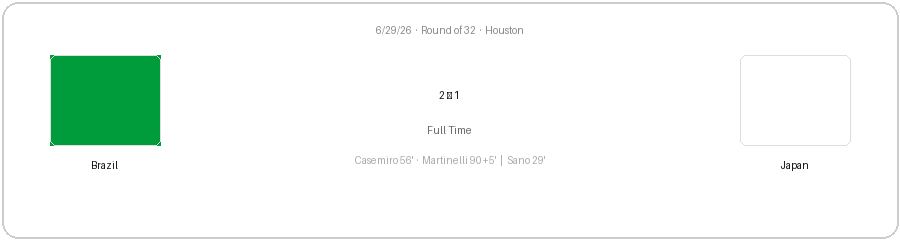
6/29/26: Brazil 2 — Japan 1 (Stats)

To start this game Japan opted, strangely enough, to sit in a low block and let Brazil have the ball, which the Brazilians happily complied with as they dominated the game early on. After Japan scored a surprise goal against the run of play at 29′, they retreated into an even lower block and gambled on playing defense for 70 minutes. Brazil became Spain, forced to play possession-style in compressed space. Japan’s tactic eventually faltered as Brazil equalized through a Casemiro header at 56′ from an assist by Gabriel. OT was avoided when Martinelli scored the game winner in injury time at 90+5′. Japan’s decision cost them dearly. Why would a team quite capable of attack simply defer and let the other team dictate? Because that can actually work (see Spain vs. Cape Verde post). While Japan counted on their discipline to defend, Brazil was able to resort to their legendary jogo bonito to pull out the victory. Before Martinelli’s strike, Vinicius nutmegged a Japanese defender at midfield and dribbled into the 18-yard box before shooting at goal in a canonical display of their style.

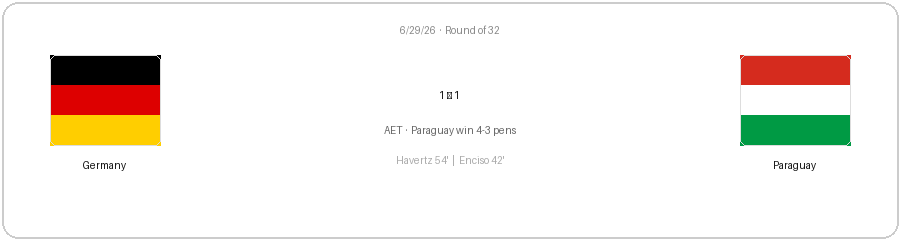
6/29/26: Germany 1 (3) — Paraguay 1 (4) (Stats)

This game was a perfect example of soccer’s paradox. How does a team that dominates every statistical category still lose? Paraguay eliminated Germany on PKs. Germany had 725 accurate passes to Paraguay’s 160, and 76% possession to Paraguay’s 24% — the most glaring examples. A potential winner by Tah was ruled no goal due to a foul on the Paraguayan keeper. While Germany outperformed Paraguay in every statistic, they underperformed in the most relevant part of the game — the one that decided the tied match — the PKs. But the losing team should never be blamed for that. It’s always a crap shoot.

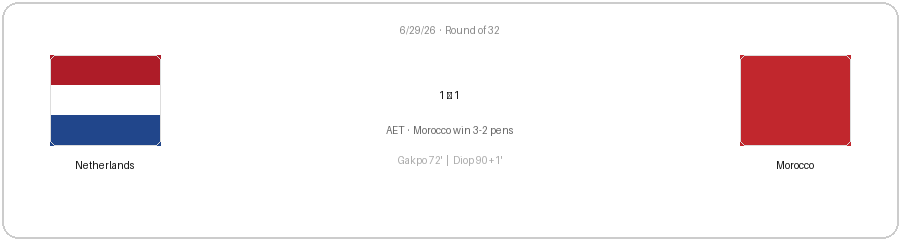
6/29/26: Netherlands 1 — Morocco 1 (PKs: Morocco 3-2) (Stats)

Morocco dominated in possession stats (70% to 30%) but Netherlands scored a lightning-fast counter-attacking goal: the Dutch goalkeeper kicked it to a player in the middle, who headed it to a speedy winger who beat his man and, from the ground, passed it to Cody Gakpo, who scored. Three passes, ten seconds, a goal. Full stop. Not quite. Gakpo’s celebration was extra emotional, as he and his wife had lost a child 48 hours before kickoff. Issa Diop, Morocco’s CB, equalized on a header at 90+1′. Morocco prevailed in PKs. Justly so.

6/30/26: Mexico 2 — Ecuador 0 (Stats)

Mexico started this game like they were trailing 0-2 and desperate to get back in. It was a tactic reminiscent of Mexico’s approach against Germany in the 2018 edition when they surprised the Germans with an opening 2-1 win. Mexico sought to capitalize on the home field advantage right away, and they accomplished exactly that. This paid off at 22′ when Quiñones scored. Building from the back and then playing a direct ball over the top broke two defensive lines and launched Julián to a 1v1 opportunity against the lone defender. He did not hesitate or take an extra dribble but instead finished with a thunderous strike, driving the Azteca to a boiling point. The temperature was raised a bit more when Raúl Jiménez scored a second at 31′. After intercepting a pass and playing to his left, the ball was quickly passed back to him right in front of goal and, like Mbappé against Sweden, he took a slight touch before shooting quickly with the outside of his foot, swerving the ball away from the Ecuadorian keeper. Mexico’s engine up to that point was 17-year-old Gilberto Mora. Mexico ground out the victory in an ugly second half. Ecuador had the bulk of possession but did not really threaten at all. The Azteca, and all of Mexico, partied all night after Mexico won their first knockout victory since 1986, finally getting the “quinto partido.” In the process, Mexico set a record for winning the first 4 games without conceding a goal, becoming only the 5th team in World Cup history to do so.

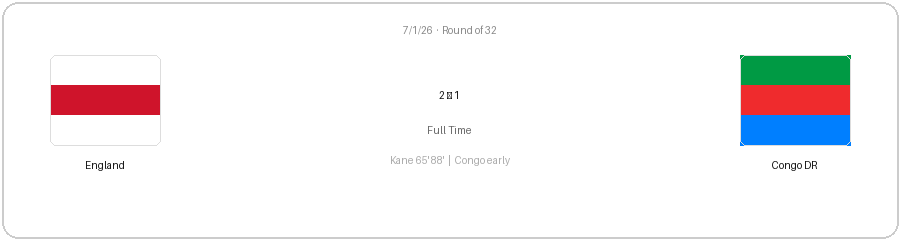
7/1/26: England 2 — Congo 1 (Stats)

Congo scored a whippet of a goal early and hoped to hold off the Three Lions until Harry Kane finally got one past the Congolese keeper, who had up to that point played the game of his life making one astonishing save after another. England’s depth proved to be too much and wore Congo down. The best example was when Rashford was substituted by Saka — one superstar player for another. That wore Congo out. In the 88th, Kane, surrounded by three defenders, dribbled to his right away from all of them and delivered the winning goal. Kane, Mbappé, Messi — these are the elite players of the World Cup. They won games for their teams when the pressure was highest. One of these three teams should now be favored to win it all. England faced Mexico at the Azteca. We would find out if the vaunted stadium is truly one of the hardest in which to play the host country. Mexico better hope another Maracanazo is not in store. England last played there against Argentina in 1986. The ghost of Maradona would loom large in British minds.

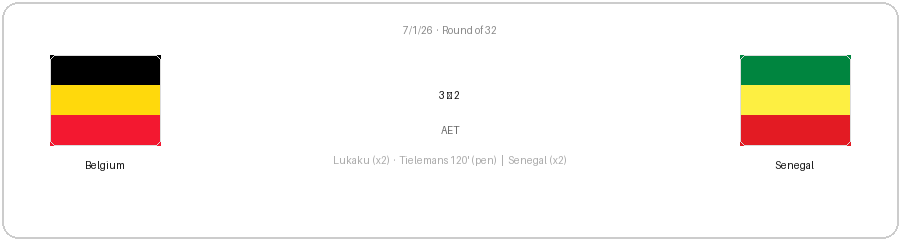
7/1/26: Belgium 3 — Senegal 2 (Stats)

What is the most dangerous lead in soccer? It is a well-worn cliché that it is 2-nil, of course. Belgium pulled off another 3-2 win at the World Cup — in 2022, they came back against Japan in the second most exciting game of that tournament, second only to the final. Senegal owned the Red Devils for 80 minutes before Lukaku scored twice to equalize. Tielemans scored on a PK in the dying minutes of extra time, sparing everyone from the dreaded shootout. The PK was highly controversial and may not have been warranted. It was the second game of the day in which a superstar saved his country by scoring two goals.

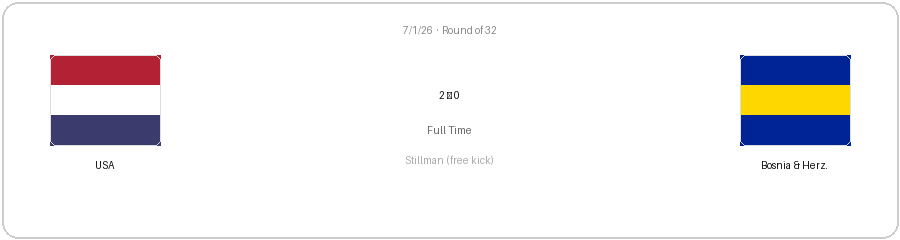
7/1/26: USA 2 — Bosnia & Herzegovina 0 (Stats)

BiH had one good chance early and one late. In between it was a sandwich of total US dominance. Not even a dubious red card to the US’s best player, Christian Pulisic, made a difference. The US’s Stillman scored on a cracking free kick to double their lead. The card would hurt the US moving forward as they faced Belgium.

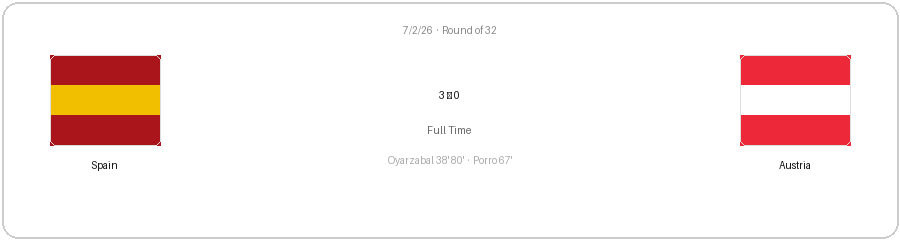
7/2/26: Spain 3 — Austria 0 (Stats)

Two things stood out in this game for La Roja: they maintained their highly elevated possession game but played at a much higher tempo. Not surprisingly, Spain had the highest average percentage of possession — 69% — of any team in the World Cup. But unlike in group play, Spain played faster and with more urgency. Oyarzabal scored at 38′ but they buzzed at the Austrian goal like bees at their queen’s nest, hitting posts and forcing saves from the keeper in a hurried but purposeful frenzy. They could easily have scored two or three. Lamine Yamal returned to his dynamic self after his hamstring injury. Rodri also looked better, playing at a faster tempo. In that regard, Spain resembled France more than their usual methodical selves — meaning they were more direct. No 50 passes per shot attempt. That would no longer cut it. Second-half dominance continued. Porro scored on a header at 67′ and Oyarzabal scored a second later in the half. Spain was on the rise, similar to Argentina in 2022. After a slow start, La Roja played their best game and started to peak at the right time.

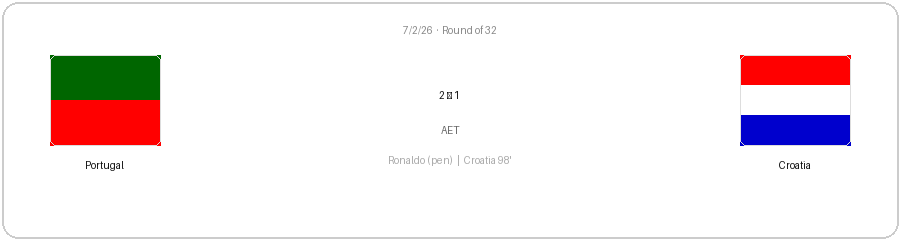
7/2/26: Portugal 2 — Croatia 1 (Stats)

It was a vibrant match with the best back-and-forth of the Cup so far, with pace and quality on both ends. Portugal opened the scoring and Ronaldo equalized with a surgical PK. This may have been the most controversial game, especially for Croatian fans. The PK itself came on a clear grab of the back, albeit with very slight contact. Croatia equalized at 98′ when a cross appeared to involve both a Croatian flick and the back of a Portuguese defender before being handled by a Croatian player. Was he offside or wasn’t he? That will be debated for a long time. CR7 and Portugal advanced, but because they had conceded the group to Colombia, they faced rival Iberian Spain — a rematch of the UEFA Nations League final from the prior year. It was a shame one of these giants would eliminate the other.

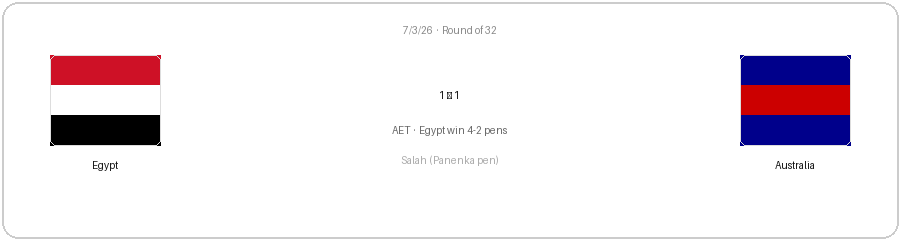
7/3/26: Egypt 1 (4) — Australia 1 (2) (Stats)

The Australians made two mistakes: they changed keepers for PKs, and had two center-backs take two of the first three kicks — both missed. Mo Salah with a Panenka — a gorgeous and audacious take. Love anyone with the audacity to do that.

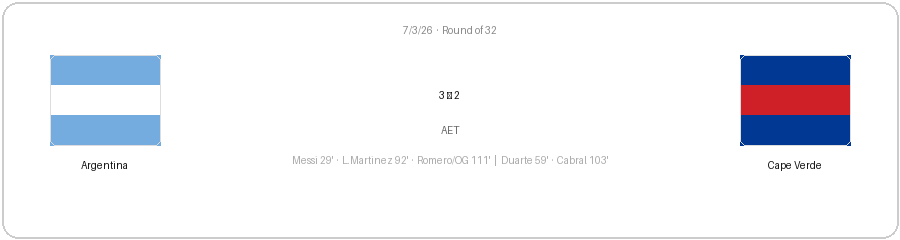
7/3/26: Argentina 3 — Cape Verde 2 (AET) (Stats)

At the onset of this game, who would have thought that a country of 500,000 people could possibly beat the reigning World Cup champion, with the best player on the planet still performing at a high level, and with most of his mates still around seeking the vaunted repeat? The resistance lasted almost half an hour. Messi scored at 29′ on an exquisite trap of a long pass and a quick shot. Messi channeled his inner Michelle Obama — when the keeper goes low, you go high. As great as Vozinha had been, he was no match for the GOAT on this play. Impeccable technique from the all-time World Cup scoring leader, with 20 tallies and Mbappé in hot pursuit with 18. Apparently Messi is a late World Cup goal-scoring bloomer. He netted only 6 in his first 3 World Cups and has now exploded for 13 in the last two. The wine analogy fits like a glove. The second half was a surprise. Cape Verde equalized at 59′. Messi was denied by Vozinha on a free kick — as Vozinha was still organizing the wall, Messi quickly took the kick and angled it to the right post. Vozinha raced to it and deflected the ball out at the last second. If you were keeping score of the personal matchup, it was now 1-1. The game ended knotted at 1 at the end of regulation. At 92′ of extra time Lisandro Martínez righted the ship with a shot roofed into Vozinha’s left after collecting a Mac Allister flick to the back post from a corner kick. At 103′, stunner v2.0 — an unknown player named Sidny Lopes Cabral scored a “bend it like Beckham” postage-stamp curling missile to tie the game at 2. WTVF!! (V is for Veritable). At 111′ the normal order of things was restored when Romero headed a corner kick off a Cape Verde defender and past Vozinha — officially credited as an own goal. Minutes later Cabral almost scored again, but his free kick, destined for the back of the net, was saved by Emiliano Martínez — possibly the save of the Cup. And if that wasn’t enough, Martínez made another save, barely getting to a loose ball in the box ahead of a Cape Verde player. Martínez delivered again, clutch save after clutch save. Remember his kick save that staved off France in extra time of the 2022 Final. A remarkable game. The best and most dramatic game since the 2022 World Cup Final.

Argentina Survive Cape Verde

7/3/26: Argentina 3 — Cape Verde 2 (AET)
Hard Rock Stadium, Miami Gardens

Full Match Highlights

How is it possible that a nation of 500,000 souls — roughly the population of Fresno, California — nearly toppled the reigning World Cup champions, the most decorated squad on the planet, anchored by the greatest player who has ever laced up a boot. The Blue Sharks fought back from a goal down not once, but twice, and looked every bit Argentina’s equals as the game wore on, with the favorites fading in the second half and extra time while Cape Verde only grew stronger — physically and in belief — the longer it went. Football can be a magnificent, cruel, and yet beautiful game. Al Jazeera

Cape Verde had held mighty Spain scoreless for 90 minutes in the opener for both teams. In this game, the resistance lasted a respectable 29 minutes. Then Messi happened, as Messi tends to do. Lisandro Martínez lofted a perfectly weighted pass toward him; Messi snuck behind the Cape Verde defense on a well-timed run, fielded the ball with sublime skill on a short-hop, and then quickly hammered a finish into the roof of the net past goalkeeper Vozinha for a 1-0 lead. Messi channeled his inner Michelle Obama — when the keeper goes low, you go high. Impeccable, inevitable, infuriating for the opposition. That was his 20th World Cup goal, extending his all-time record and moving two ahead of Mbappé on the all-time list, who is in hot pursuit with 18. Watch the goal. FOX SportsFOX Sports

Messi is a late World Cup bloomer of the finest vintage. He netted six goals in his first three tournaments before erupting with 13 in the last two. The wine analogy fits like a glove. He is, at 39, somehow getting better at the highest-stakes moments. He also became the first player in history to make 30 World Cup appearances tonight. At some point the superlatives simply run dry. YouTube

The second half, however, belonged to the extraordinary. Cape Verde equalized at 59′ when Deroy Duarte slammed home past Emiliano Martínez to send the Cape Verdean pocket of fans into delirium and silence the overwhelmingly pro-Argentina crowd in Miami. Then came the great Messi-vs.-Vozinha subplot that would have been worthy of its own short film. Messi was denied by Vozinha on a free kick — as he was still organizing the wall, Messi quickly took the kick, and angled it toward the right post. Vozinha, all 40 years of him, raced across and deflected it out at the last second. If you’re keeping score of the personal duel, it was 1-1. The game ended knotted at 1 at the close of regulation.

Then extra time delivered something nobody was ready for.

At 92′, Lisandro Martínez — the same man who’d assisted Messi’s opener — roofed a left-footed effort into the net at the near post from a corner kick situation, seemingly restoring order. The previously silenced Argentinians, sent on a frenzy of joy. For about eleven minutes. Because at 103′, an unknown left back named Sidney Lopes Cabral intrepidly inserted himself into the script.

The Cabral goal had come at the end of a passing sequence that started deep in Cape Verde’s half, involved Vozinha, and saw them pass their way out of an aggressive Argentine press with a calmness and assuredness that no World Cup debutant should have against opposition like this. Then Cabral — a left back, playing as a left back — jinked inside and curled a pearler with his right foot into the far top corner. Postage stamp. Bend it like Beckham. WTVF!! (V is for Veritable.) Watch the Golazo. Lionel Messi stood there, staring sheepishly into space. Emiliano Martínez looked around, disbelief etched on his face. Alexis Mac Allister couldn’t bear to look up. This was not how the plot was supposed to unfold. The scrappy Cape Verdeans would simply not be denied. YouTubeYouTube

Normal order was finally, mercifully restored again at 111′ when Romero’s header glanced off Cape Verde defender Diney Borges and crept past Vozinha into the far corner — officially credited as an own goal — to make it 3-2. Surely this was the coup de grace. But Cape Verde wasn’t having it. Cabral nearly scored again, his thunderous free kick destined for the net before goalkeeper, Emiliano Martínez pulled off possibly the save of the tournament, barely getting a touch on a loose ball in the box ahead of a charging Cape Verde attacker. Clutch save after clutch save. Remember his save that staved off France in the 2022 Final? The man is constitutionally incapable of wilting under pressure. thespread

Argentina’s xG on the night was 2.16 against Cape Verde’s 0.45 — and yet here we were, in extra time, panting, hearts pounding, the whole footballing world transfixed. The data said Argentina should have won comfortably. The game said otherwise. thespread

A remarkable match. Cape Verde — the smallest nation by land area ever to qualify for a World Cup, with a population roughly 1% the size of Argentina’s — go home with heads held impossibly high and a country’s worth of stories to tell their grandchildren. Their coach Bubista summed it up gracefully: “Argentina is a world champion and they have one of the best players in the world, so that in itself speaks of the challenge it was for our team to overcome them. We want to evolve so that we can have more opportunities to face the so-called big dogs of the tournament.” NBC SportsNBC Sports

Long live the Blue Sharks. Argentina advance to face Egypt in Atlanta. The GOAT lives to fight another day.

The best and most dramatic game since the 2022 World Cup Final.

The Real World Cup

The World Cup is a tale of two tournaments.  In the first round, it’s a tournament about hope, happiness, and mirth. In the knockout phase, it’s a tournament about reality, despair, and despondency.  The first round is the party time, the second the business time.

One watches the first round full of optimism and hope about one’sfavorite team.  Anything can happen, the possibilities are endless.  If the team play well and loose, if the team avoids major injuries and catches a break here and there, then anything is possible. A team can get to the knockout phase without winning all of its games.  The party has just started and it is a good party.

As the games progress, as one does the math, certain things become evident.  The possibilities of advancing are calculated. By the time of the third game, when the group matches are played simultaneously, there’s a more serious air to the affair. Elimination is now a distinct possibility.  But if your team gets through, a joyous feeling radiates among the fan base, like the bright orange glow of a glorious sunset.

Once the teams are set for the following round, pundits and fans begin the analysis phase. It’s once again hope that maybe you can win a game or two, to have a good run as they say. For the major teams, the Brazil, Argentinas and Germany’s of the world, this is a more serious time, one in which the expectations of the nation become a burdensome weight.  For other teams, hope again springs eternal.

The tension of the second phase is evident from the kickoff.  What one encountered as bliss in the first phase (yey the World Cup has finally started) is now a heavy knot of worry felt in the gut of the common fan. A defeat at this stage strikes with the force of a knockout punch, the finality of the moment hits home hard.

In this World Cup, teams such as Mexico, Algeria, the US, Switzerland, Chile felt the pain firsthand.  First, Chile lost to Brazil after a scoreless 120 minutes in the dreaded penalty shootout.  Trailing  by one goal at 3-2, they needed a goal from their last kicker to stay alive.  When the kick struck the right post, caroomed all the way across, flying across the sprawled goalie, and safely stayed out of the net, the Chileans were eliminated. This was even worse because Chile had hit the crossbar late in the game, sometime around the 118th minute, a ball that if it had gone in, would have eliminated the host country Brazil. Such a dramatic victory could easily have been categorized as a second Maracanazo for the annals of history. Maybe it would not have been as as dramatic as Uruguay beating Brazil in the 1950 final, but a close second considering that Brazil would have been eliminated from the only other tournament they’ve hosted since 1950 at the beginning of the knock-out phase.

Mexico lost in just as heartbreaking of a manner.  Leading 1-0 on a goal from Giovanni Dos Santos until the 88th minute, Holland scored when Sneijder took a defensive clearance and shot a rocket into the corner that Memo Ochoa had no chance on.  Ochoa had played remarkably well and had kept Holland at bay with a number of incredible reflexive saves.  About 4 minutes later, in stoppage time, Arjen Robben dribbled into the penalty area, and then after a clumsy challenge from Rafa Marquez, took what appeared to be a dive. The referee did not flinch and signalled to the penalty spot.  Holland converted, and just like that, Mexico went from winning one of the most important games in its history (they’ve only advanced to the quarter-finals once) to losing yet another Round of 16 game.

Similarly, Algeria battled Germany to a scoreless tie for 90 minutes, only to see Germany get two goals in the extra period. While Algeria got one back, it was too little too late and Germany once again advanced into the quarterfinals.

Argentina required 118 minutes before vanquishing a tougher than anticipated Swiss side (the same side that got plastered 5-2 by France in the group stage).  It took a darting run, a moment of brilliance from Messi to define the outcome. After a Swiss turnover, Messi received a pass near midfield before eluding two defenders. Two additional Swiss came at him. At that moment, Leo passed the ball to his right to DiMaria, who slotted the ball coolly on the ground to the far post to beat the Swiss keeper.  But Argentina had to sweat it out in the final minutes. On a corner kick, Switzerland’s Dzemaili headed the ball straight into the post. To add insult to injury the rebound also hit his foot and went inches wide.

The USA Belgium game followed a similar script that the other American games had.  The US was dominated by the opposing team in terms of shots and corner kicks (although it boggles the mind understand how they won the possesion game 53%-47%). Belgium uncorked a record 27 shots on Tim Howard. He stopped a World Cup record number 15 of them. Belgium finally had the breakthroughs in the extra-time as DeBruyn and Lukaku scored one each. Lukaku’s fresh legs and energy provided the spark for both goals. The US got one goal back from Julian Green late in the game, begging the question why Klinsmann didn’t bring him in for the the entire extra period. The US had one more opportunity off of a set piece to put the game into penalties but Dempsey’s shot was stopped by Courtois.

To quote US keeper Tim  Howard: “It’s really awesome getting through the group, but it means nothing. The sting of failure is the same if you lose in this round as if you didn’t get out of the group.”

To paraphrase Dickens, the Spring of Hope gives way to the Winter of Discontent.